
City applies remaining Faircloth authority to RAD pipeline, seeks HUD rent-augmentation
Get AI-powered insights, summaries, and transcripts
Subscribe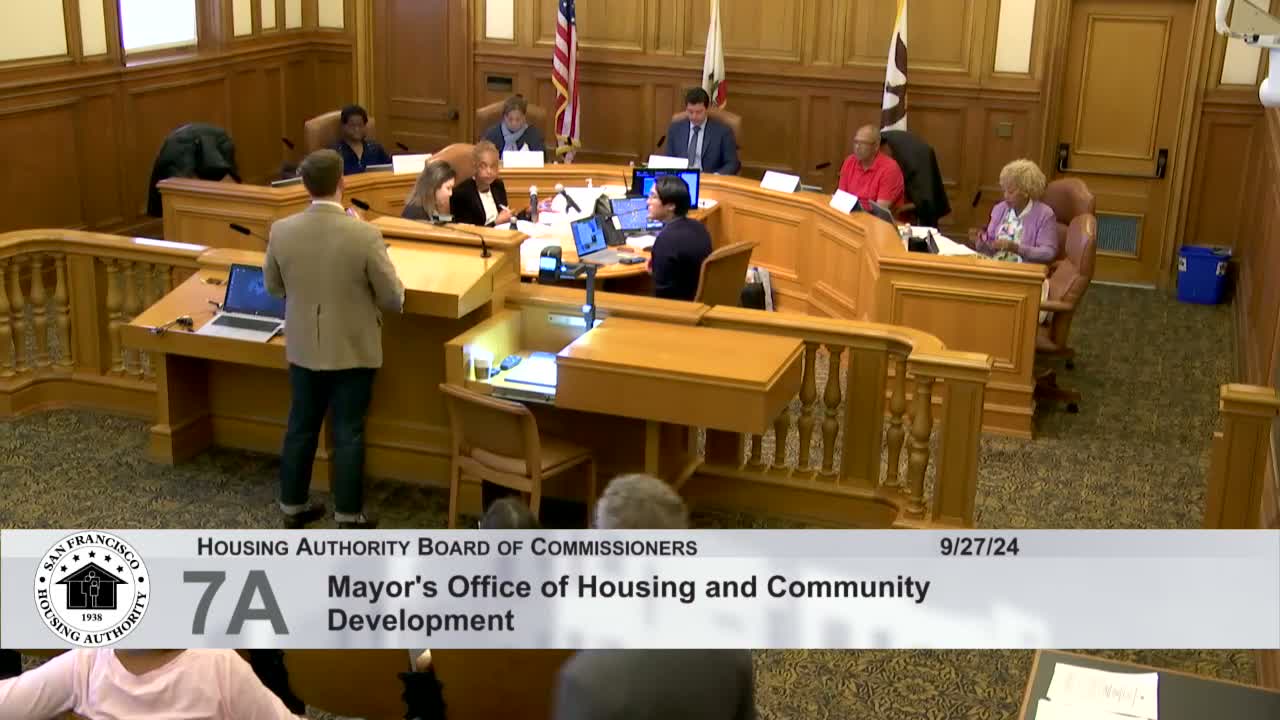
Summary
The Mayor's Office of Housing and Community Development told the Housing Authority it submitted notice requests to HUD to preserve the city's option to convert 3,667 units of remaining Faircloth authority into Section 8 RAD contracts and to use a limited HUD rent-augmentation pilot that tops RAD rents using HAP reserves.
The Housing Authority heard a presentation from the Mayor's Office of Housing and Community Development on the city's effort to convert unused Faircloth public-housing authority authority into project-based Section 8 contracts through HUD's Rental Assistance Demonstration (RAD). Dan Adams, director of MOHCD, introduced the presentation and William Wilcox, bond program manager, explained the mechanics and constraints.
"We have 3,667 units of remaining fair cloth authority," Wilcox said, describing the stock the city could convert. He framed the Faircloth-to-RAD option as a way to create stable, long-term operating subsidies while also leveraging tax-credit and other financing to make new construction or preservation financially feasible.
Wilcox told commissioners that RAD rents alone are usually insufficient to cover development and operating costs and that local gap funding remains necessary. He said HUD issued a rent-augmentation pilot allowing housing authorities to use HAP reserves to top up RAD rents up to payment standards, but that the pilot required a Sept. 30 application; MOHCD submitted notice-of-available-RAD-rent (NAR) applications before that deadline to preserve the city's ability to use the augmentation.
Commissioners asked whether other housing authorities were pursuing the same path. Wilcox said examples are limited but cited Worcester and Alameda as jurisdictions advancing comparable conversions and noted moving-to-work PHAs have alternative pathways. He said the program involves an extended HUD approval process and careful selection of an initial project cohort because the number of conversions the authority can undertake each year is limited by available HAP reserves.
Wilcox described the intended approach as cautious: submit applications to preserve options, identify early-stage projects in the city's new construction pipeline for conversion, and layer RAD augmentation, HAP reserves and local gap financing to keep projects feasible. He emphasized the approach does not commit the city to specific projects or timelines but preserves the opportunity to use the conversion option in the future.