Get Full Government Meeting Transcripts, Videos, & Alerts Forever!
Get email alerts on the Elective Pay Green Bank topic
No spam. Unsubscribe anytime.
Think tank urges San Francisco to pair public bank with IRA 'direct pay to finance clean-energy projects
Summary
The Center for Public Enterprise told LAFCO that a San Francisco public bank could provide construction finance and technical capacity to monetize Inflation Reduction Act elective pay for tax-exempt city projects; presenters highlighted no per-project cap on elective pay but noted domestic-content rules and a 15% reduction if tax-exempt bonds finance a project.
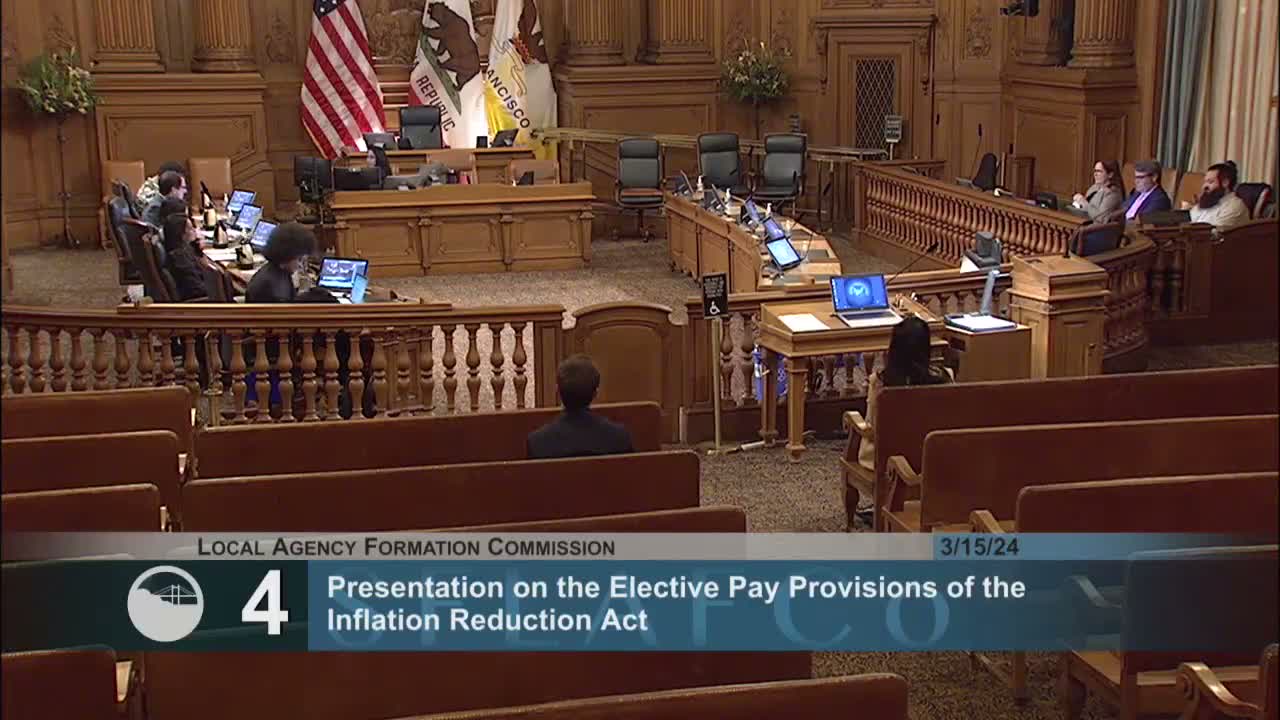
Advait, an energy-policy associate with the Center for Public Enterprise (CPE), presented to LAFCO on March 15 on how a San Francisco public bank could accelerate local clean-energy development by combining construction finance with the Inflation Reduction Act's elective (direct) pay provisions.
CPE described a public bank that issues financing, takes equity stakes in troubled projects, and operates revolving funds to lower the cost of capital for projects that otherwise would be difficult to finance privately. "A public bank could help make the marginal project bankable," Advait said, arguing a public-lender model reduces financing costs and helps projects reach construction.
On elective pay, Advait explained the program permits tax-exempt entities, including city instrumentalities and nonprofits, to receive cash payments equal to applicable federal tax credits once a project is placed in service. CPE emphasized there is "no cap on the amount of elective pay we can receive" and that elective pay can represent roughly 30% to 50% of a project's basis, though he cautioned projects must meet federal domestic-content requirements and certain financing structures (for example, projects financed directly with tax-exempt bonds) can reduce elective pay by 15%.
Advait recommended centralizing technical assistance and IRS/tax-form expertise in a public bank or other city node to manage complex compliance tasks such as domestic-content tests, project labor agreements and elective-pay filings. He also offered CPE's elective-pay financial model for use by SFPUC and Clean Power SF to compare publicly owned vs. PPA-style project designs and to assess whether a public bank should buy or monetize private tax credits under future rule changes.
Chair Connie Chan directed staff to refine the presentation with city finance offices, the controller's office and the capital planning committee to develop a San Francisco-specific financing picture. Advait said CPE will explore special tax districts and other existing budgeting tools and work further with LAFCO if requested.
There was no public comment on the item.