Get Full Government Meeting Transcripts, Videos, & Alerts Forever!
Get email alerts on the Utilities Policy topic
No spam. Unsubscribe anytime.
LAFCO approves resolution to study Golden State Energy as an alternative to PG&E
Summary
After presentations from Reclaim Our Power and public commenters, the Local Agency Formation Commission voted 3-0 to accept a study proposal to evaluate implementing the Golden State Energy Act (SB 350) as a public, not-for-profit alternative utility and to transmit the study to the governor and state legislators.
The San Francisco Local Agency Formation Commission voted unanimously to accept a study resolution exploring the Golden State Energy Act and a public utility alternative to investor-owned PG&E.
Reclaim Our Power campaign presenters Antonio Diaz and Travis asked the commission to authorize a study to define how Golden State Energy (outlined in SB 350) could operate as a publicly accountable, not-for-profit utility and as a provider of last resort if an investor-owned utility failed. The presenters argued the alternative would prioritize public-interest financing, local control and equitable transitions for low-income and frontline communities.
Travis described key study topics the coalition seeks to resolve, including governance structures, financing paths, the role of the California Infrastructure and Economic Development Bank, distribution system operator (DSO) models to encourage local distributed energy resources, and tenant protections tied to program-funded retrofits. "Golden State Energy is a provider of last resort," he said, framing the study as a way to make the statute operationally meaningful.
Commissioners discussed loan terms, tenant protections and national examples. Commissioner Hope Williams asked whether other jurisdictions have pursued similar models; presenters pointed to a ballot initiative in Maine as one example of broader municipalization efforts. LAFCO Executive Officer Jeremy Pollock described parallel LAFCO work on green bank financing and the Inflation Reduction Act’s GGRF funds, and said he will continue coordination with departments and coalitions preparing applications.
Public comment included multiple callers and in-person speakers who urged LAFCO to approve the study resolution, recounting wildfire-related harms, outages, and rate impacts they attribute to PG&E’s performance. Supporters stressed the need for equitable governance and protections for low-income customers if new financing or utility models move forward.
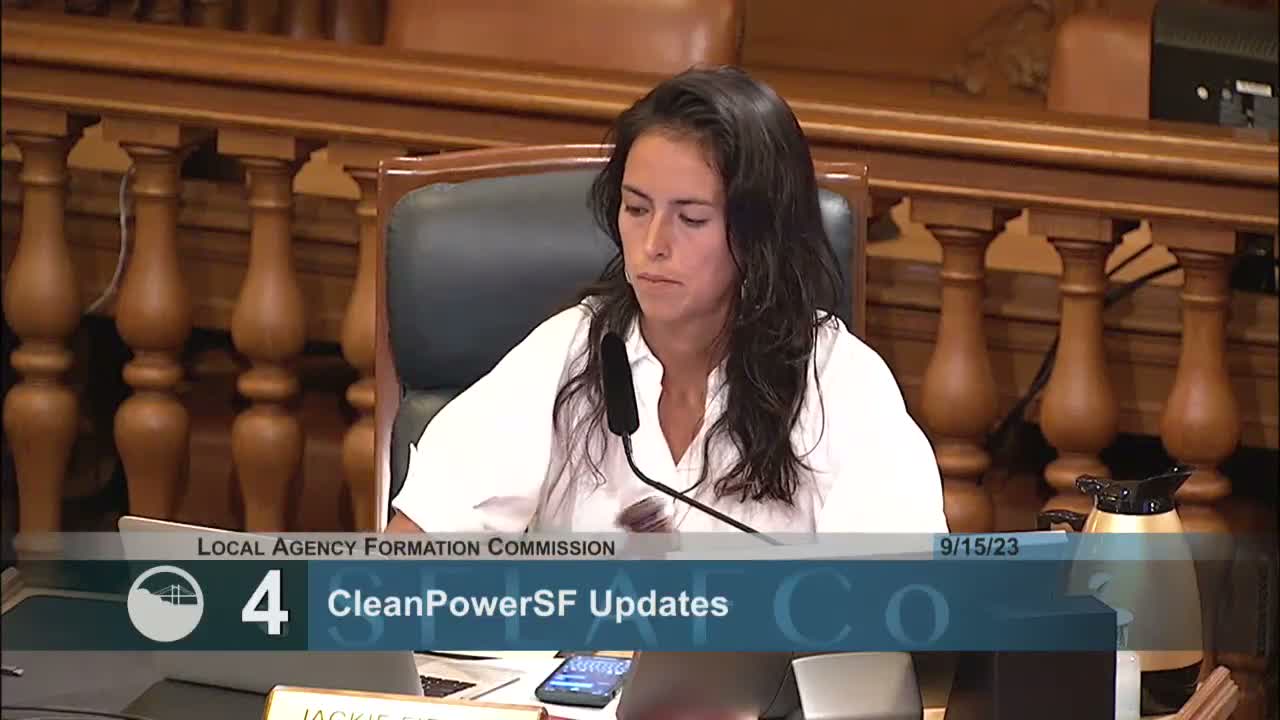
Vice Chair Jackie Fielder moved to accept the study proposal and direct the executive officer to transmit copies to the governor and the city's state legislative delegation; Commissioner Hope Williams seconded. The clerk called the roll: Preston, aye; Williams, aye; Fielder, aye. The commission approved the resolution (3-0).
The resolution directs LAFCO staff to transmit the study proposal to the governor and San Francisco's legislative representatives; next steps include staff coordination with city departments and participation in coalitions preparing federal funding applications.