Get Full Government Meeting Transcripts, Videos, & Alerts Forever!
Get email alerts on the Delivery Workers Survey topic
No spam. Unsubscribe anytime.
LAFCo releases survey showing many delivery workers earn low weekly pay after expenses; Prop 22 seen as a constraint
Summary
LAFCo commissioners heard a UC Santa Cruz survey showing delivery-workers’ median weekly earnings before expenses were about $450 and may fall to $270 after mileage; many respondents lack health insurance, and presenters warned Proposition 22 could constrain local protections.
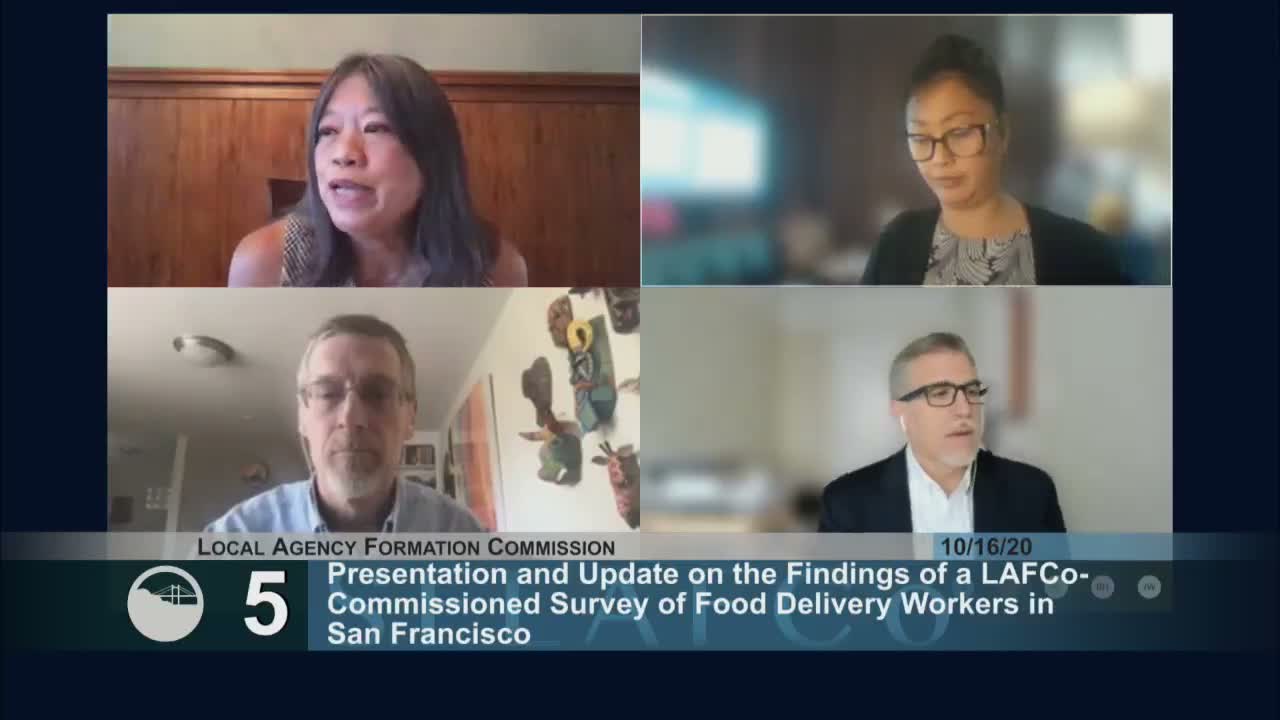
At its Oct. 16 meeting the San Francisco LAFCo released an updated survey of app-based delivery workers conducted for the commission. Professor Chris Benner of UC Santa Cruz presented findings showing a predominantly people-of-color workforce, a large share who support dependents, and median weekly earnings that fall substantially once expenses are accounted for.
Executive Officer Mr. Goble introduced the study and Professor Benner said the summer survey focused on platform delivery workers (DoorDash, Instacart, Amazon Fresh). Response rates in the field sample were high (reported values included 81% for DoorDash, 88% for Instacart and 79% for Amazon Fresh in this sample). Benner summarized demographic and economic findings: roughly 75% of respondents were people of color, about 36% were foreign-born, 67% supported others with their earnings (69% supported children), and the workforce skewed male but with higher female shares for grocery delivery.
On pay, Benner said median weekly earnings before expenses were about $450 in the sample; using mileage-based expense estimates reduced the median to approximately $270 a week, and the presenter said that approach implied as many as 12% of respondents might effectively earn nothing once full vehicle expenses were considered. Benner emphasized that delivery work in the sample is often primary employment — over half reported more than 30 hours per week and 30% more than 40 hours — and many respondents reported significant unpaid time while waiting for orders.
Benner and LAFCo staff said the study supports concerns that app-based delivery workers face precarious pay and lack access to benefits; they noted that Proposition 22 (a November ballot measure at the time) could sharply limit local regulatory options, and Benner said follow-up, in-depth interviews of respondents might be possible before the election to capture worker views on Prop 22 if resources allow.
Public commenters reiterated policy ambitions. Eric Brooks urged the city to pursue open-source, city-run apps for ride-hail and delivery as an alternative business model and recommended that LAFCo study vehicle-electrification subsidies and comparisons to legacy delivery drivers.
The commission requested staff consider whether limited follow-up interviews on Prop 22 attitudes could be completed and reported back in a memo.
Next steps: Benner said the team will seek additional funding to expand survey scopes and to disaggregate practices by platform; commissioners asked for follow-up work and for any feasible short-term interview results to be circulated to the commission.