Get Full Government Meeting Transcripts, Videos, & Alerts Forever!
Get email alerts on the Local Renewables And Implementation topic
No spam. Unsubscribe anytime.
Consultant finds SFPUC draft local‑renewables report useful but incomplete; recommends site‑level pro formas and implementation schedule
Summary
VANR consultant Jenny Whitson told LAFCO the SFPUC draft local renewable energy report identifies roughly 105 MW potential across 132 city/regional sites but lacks consistent site‑level economic analysis, project timetables and explicit disadvantaged‑community project entries; VANR recommended adding site pro formas, a two‑year implementation horizon for high‑suitability sites, and expanding consideration of brownfields and a 100% local renewable tier.
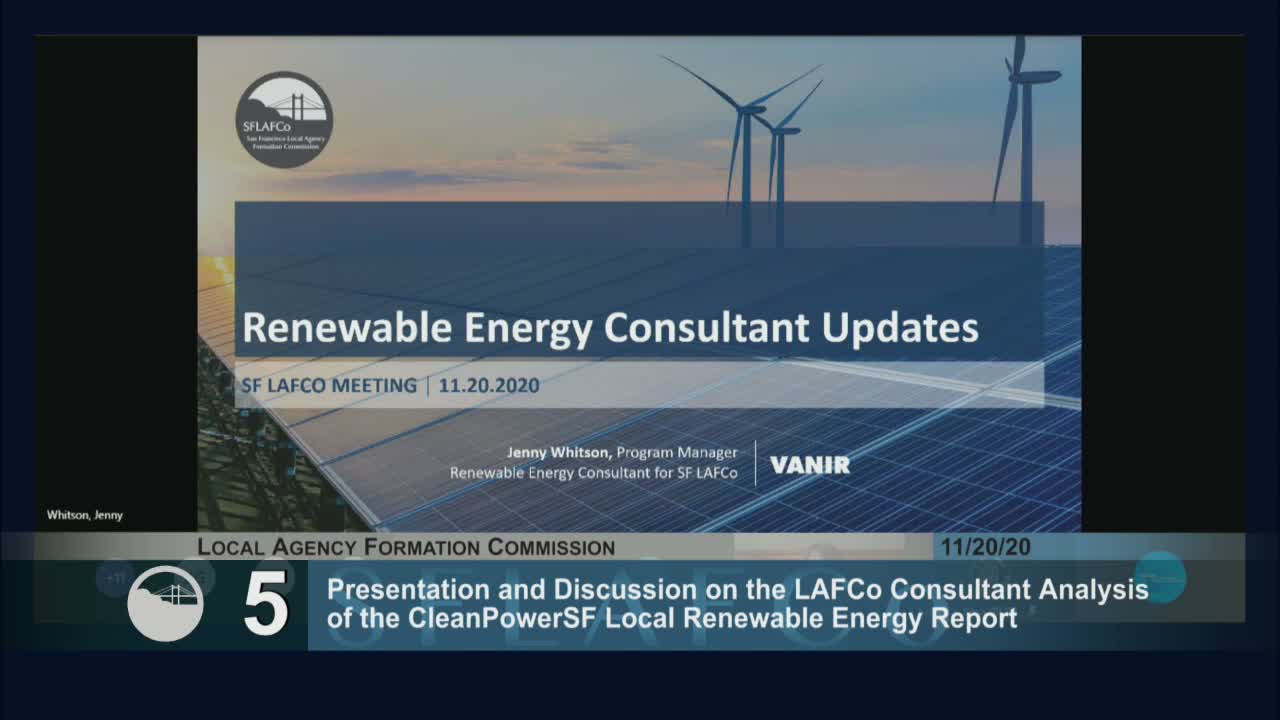
Jenny Whitson, program manager for the consultant team (VANR), presented an in‑depth review of the San Francisco Public Utilities Commission’s draft Local Renewable Energy Report (issued Dec. 2019). Whitson said the draft evaluated 132 city and regional sites across 13 agencies and estimated total capacity of about 105 megawatts (medium+high suitability approx. 88 MW). The consultant team found the draft useful as a preliminary inventory but identified important gaps.
VANR’s principal concerns were inconsistent site‑level detail, system sizing that may be optimistic relative to rooftop constraints and rooftop equipment, and a lack of site‑specific pro formas and return‑on‑investment analyses. Whitson recommended that the final report include project‑level cost evaluations (pro formas, NPV, IRR and payback years), a two‑year implementation horizon and milestones for high‑suitability projects, and clearer program assumptions for feed‑in tariff (FIT) and disadvantaged community allocations.
The consultant noted technologies assessed (solar PV, battery storage, geothermal, small hydro, onshore/offshore wind, biomass, wave) and described why levelized cost ranges vary; solar PV and onshore wind were identified as the lowest cost technologies while conduit hydro and wave were higher cost. VANR suggested expanding potential program capacity by including brownfield sites and recommended that SFPUC investigate public‑private partnerships and strategic partnerships to lower costs and accelerate implementation.
Commissioners and advocates voiced disappointment that the SFPUC’s draft lacked the implementation timetable LAFCO expected. LAFCO asked the executive officer to request SFPUC provide a final draft that addresses VANR’s recommendations and to compile a citywide snapshot of agency renewable efforts for the commission’s January meeting so the commission could consider next steps, potential Board referrals, and equity‑focused priorities.
Public commenters urged bolder local action toward a city‑wide 100% locally sourced renewable plan and recommended expanding GoSolarSF funding for low‑income communities and nonprofits.
The item generated no immediate vote; commissioners requested a follow‑up timeline and responses from SFPUC on VANR’s recommendations.