Get Full Government Meeting Transcripts, Videos, & Alerts Forever!
Get email alerts on the Clean Power Sf topic
No spam. Unsubscribe anytime.
Clean Power SF reports rising arrears and outlines customer protections as it pushes for 100% renewables by 2025
Summary
SFPUC staff told LAFCO Clean Power SF enrollment is stable but arrearages are growing (about 16,800 residential accounts 90+ days delinquent as of 03/29/2021). Staff described payment plans, a new Arrearage Management Program (AMP) and outreach tied to federal LIHEAP funding, and summarized procurement work toward a 100% renewable supply by 2025.
San Francisco Public Utilities Commission staff told the Local Agency Formation Commission on April 16 that Clean Power SF participation remains steady but customer arrearages have increased and the program is pursuing both customer protections and new renewable contracts.
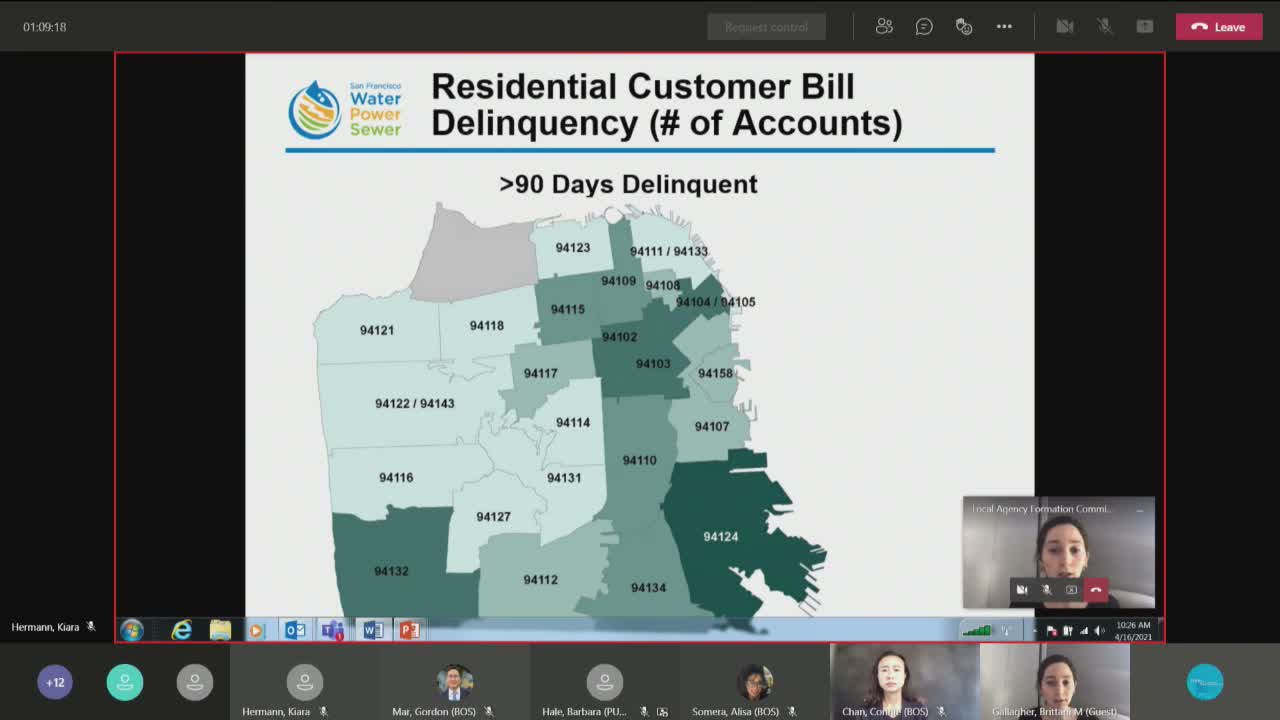
"As of 03/29/2021, there are approximately 16,800 residential Clean Power SF customers that are 90 days or more delinquent on their Clean Power SF electricity charges," said Brittney Gallagher, Clean Power SF customer solutions staff, presenting delinquency maps and trends. Gallagher said that figure represented an 8% increase compared with the prior meeting and that average overdue balances have risen for both residential and commercial customers.
To protect customers, Gallagher and other SFPUC presenters described a suite of repayment and relief options already in place or in development. These include flexible payment plans, payment extensions, and an Arrearage Management Program (AMP) that staff described as allowing eligible customers who participate in payment plans to have "as much as $8,000 in debt forgiven." Gallagher also noted state and CPUC directives that have suspended disconnections: "the CPUC has ordered PG&E and the other investor owned utilities to suspend disconnecting customers for nonpayment through June of 2021." (presenters also said SFPUC has halted returning Clean Power SF customers to PG&E for nonpayment).
Staff urged outreach to federal assistance programs and described ongoing work to connect customers with LIHEAP supports. Gallagher said supplemental LIHEAP funding from the American Rescue Plan could flow to local administrators and that San Francisco could receive roughly $2,000,000 under assumptions similar to prior CARES Act allocations; she added the supplemental LIHEAP distribution timing to local providers was not yet firm.
Clean Power SF program staff also reported progress on procurement to reach a 100% renewable supply by 2025. "Our green default service delivered over 95% greenhouse gas free energy to Clean Power SF customers in 2020, and we're working hard to get to a 100%," Kiara Herman said. Herman listed roughly 467 megawatts of contracted renewable capacity, including the Aramis project (a local 75 MW solar-plus-storage project in Alameda County) and a renewed contract with the Geysers geothermal facility through 2029, and described plans for additional solar, storage and long-duration resources to come online between 2023 and 2025.
Commissioners used the presentation to press staff on local siting and ownership. Vice Chair Cynthia Cruz Pollock asked whether projects identified in the integrated resource plan are under construction and whether any are on city-owned property; staff replied projects have been built by third-party developers under contract and that RFPs are being prepared for several high-suitability San Francisco reservoir sites.
Members of the public who called in urged LAFCO and the city to emphasize local and regional build-out, job creation, and equity. "We need a citywide and Bay Area local build-out plan to power San Francisco locally and regionally," caller Eric Brooks said, advocating workforce development and targeting disadvantaged neighborhoods. Caller Gabe Goffman and other speakers similarly urged more local projects, building-electrification incentives and resilience planning.
The presentation concluded with staff offering to provide additional status updates on large projects and to return with further detail on which IRP-identified sites are being advanced.
Next steps: staff said they will continue outreach on AMP and LIHEAP connections, finalize RFPs for local reservoir projects, and report back to LAFCO on project status and opportunities for federal funding.