Get Full Government Meeting Transcripts, Videos, & Alerts Forever!
Get email alerts on the Consumer Protection And Disconnections topic
No spam. Unsubscribe anytime.
LAFCO researcher warns CPUC decision leaves low‑income San Franciscans exposed to disconnection risk
Summary
LAFCO research associate Adiba Khan told the commission that CPUC’s decision on arrearage programs contains protections but falls short for San Francisco’s most at‑risk residents; the report recommends extending the disconnection moratorium through the COVID emergency, pursuing local debt‑relief funding, and designing a San Francisco‑specific percentage‑of‑income plan.
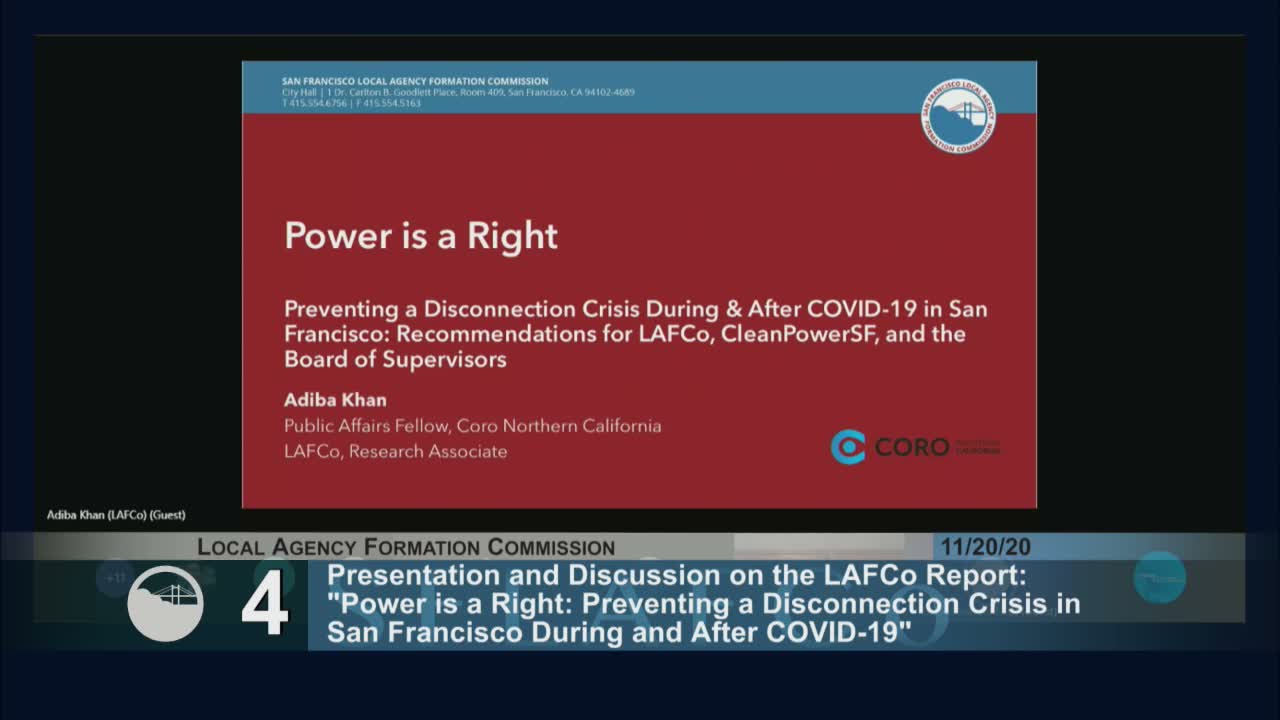
Adiba Khan, LAFCO research associate, presented "Power is a Right," a research brief assessing CPUC’s recent ruling and its implications for San Francisco households at risk of utility disconnection. Khan walked commissioners through mapping and supervisor‑district data showing the city’s most affected ZIP codes — Bayview‑Hunters Point, SoMa, Visitacion Valley, Portola, Merced Heights and the Western Addition — and demonstrated overlap between high COVID incidence and high delinquency and disconnection rates.
Khan summarized numerical findings drawn from Clean Power SF data: total outstanding debt cited in the presentation was about $4,574,607 across approximately 138,233 accounts; roughly 40% of Clean Power SF customers had some debt and about 14% had debt older than 30 days. Khan said these snapshots illustrate the populations most at risk if moratoria lift prematurely.
Khan critiqued the CPUC decision across several fronts: AMP eligibility is limited to CARE/FERA customers and requires a $500 minimum arrearage, reconnection goals are framed as non‑binding recommendations, the ZIP‑code cap on disconnections (30%) is not targeted to San Francisco, protections for Section 8 tenants were not mandated, and some vulnerable groups (seniors, new parents) were not sufficiently covered. She said the CPUC did require PG&E to eliminate establishment and re‑establishment deposits — a positive step — and to expand medical baseline certifications to nurse practitioners and physician assistants, but urged broader certification authority and multilingual outreach.
For short‑term actions, Khan recommended the SFPUC and Board of Supervisors press CPUC to extend the disconnection moratorium for the duration of pandemic emergency declarations; press for transparency on PCIA/undercollection recovery; and target local funding (CARES rounds or city general fund allocations) for debt relief and vouchers to keep households current on monthly bills. Khan pointed to Los Angeles’ Repower LA coalition as a model, where the city allocated sizable CARES funds and designed a local debt relief program and percentage‑of‑income pilot.
Commissioners asked Khan about state and federal funding opportunities and whether San Francisco could replicate LA’s measures locally; several commissioners signaled interest in drafting Board resolutions and in asking SFPUC to develop a post‑moratorium plan. The executive officer was asked to compile citywide agency activity summaries and return a one‑year work plan at LAFCO’s January meeting.
Khan’s presentation closed with both short‑term (moratorium extension, targeted relief, improved outreach) and longer‑term (percentage‑of‑income plans, stronger racial‑equity staffing and metrics, targeted energy efficiency and storage in high‑burden neighborhoods) recommendations.