Get Full Government Meeting Transcripts, Videos, & Alerts Forever!
Get email alerts on the Ebike Rebate Pilot topic
No spam. Unsubscribe anytime.
LAFCO presents e‑bike rebate pilot for delivery workers; city agencies weigh partnership options
Summary
A LAFCO‑commissioned survey found strong interest among delivery workers in switching to e‑bikes with financial incentives. Researchers recommended a worker pilot that could cover e‑bike costs for participants, require safety training, involve local bike shops, and gather data on equity and worker conditions.
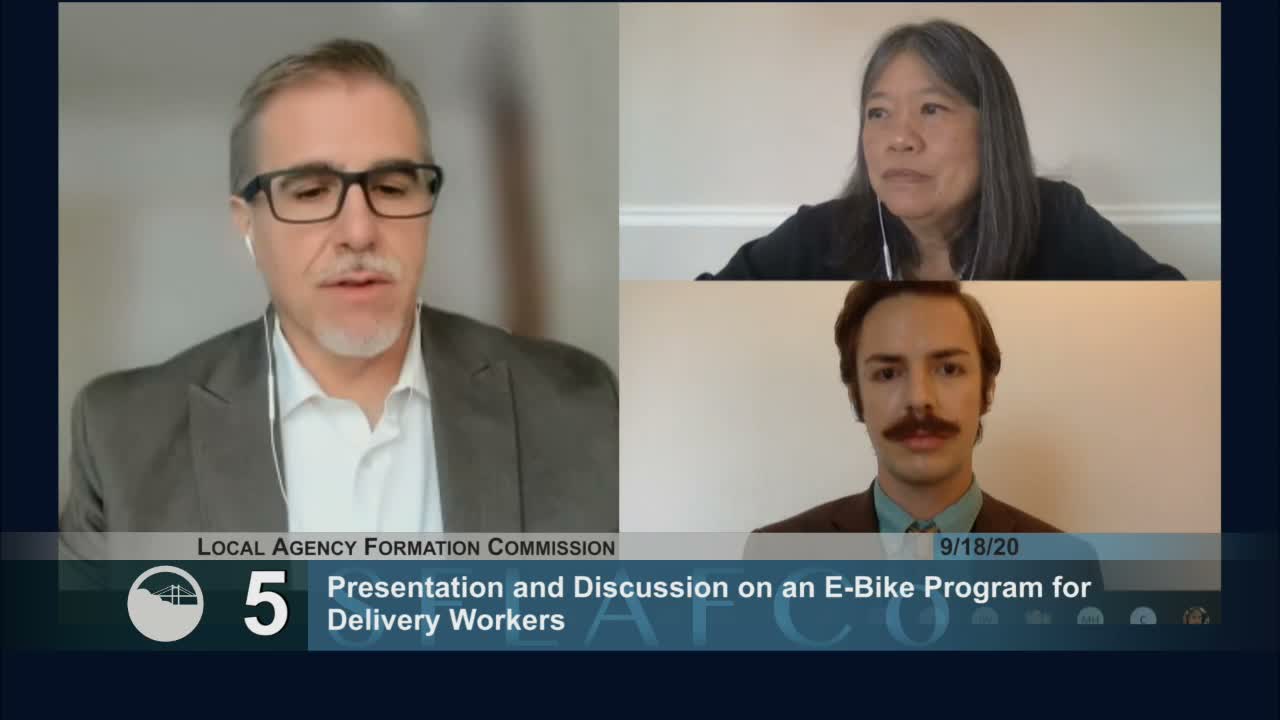
LAFCO research associate Jackson NetBeers presented Dec. 18 on a proposed electric bicycle rebate pilot aimed at food delivery and ride‑hail workers.
NetBeers summarized a truncated 2019 survey and new research that found delivery workers are disproportionately low‑income and people of color, with vulnerabilities such as a lack of health insurance and limited emergency savings. The survey indicated roughly 18% of food delivery workers use bicycling as their primary mode; 25% said they would switch to an e‑bike if offered a financial incentive, 39% said they would switch and 31% said they would consider switching.
The presentation reviewed existing rebate models (examples include $200 point‑of‑sale rebates from Holy Cross Energy and Local Motion and larger subsidies in other regions) and a program in the San Gabriel Valley that raised its rebate from $350 to $700 to spur greater uptake among low‑income households. NetBeers recommended a targeted worker pilot designed to reduce upfront costs (possibly full coverage for participants), require a bicycle safety training course, partner with local bike shops for distribution and maintenance, and collect transportation and worker condition data.
Suzanne Lisonbee from the Department of the Environment said the city is consulting with MTA and SFPUC staff on a pilot focused on delivery workers and hopes to provide low‑ or no‑cost e‑bikes in exchange for data collection, with scope and timing depending on funding and partnerships.
Commissioners discussed pilot design options including point‑of‑sale rebates, outright provision of bikes, using shared‑bike fleets, bulk procurement to lower unit cost, and supplemental protections such as insurance or theft mitigation for participants. Staff acknowledged operational concerns with shared fleets (battery availability, recharging) and agreed to consider insurance and bulk procurement options as design work proceeds. The item was informational; no action was taken.