Get Full Government Meeting Transcripts, Videos, & Alerts Forever!
Get email alerts on the Utilities Rates And Customer Relief topic
No spam. Unsubscribe anytime.
Clean Power SF reports rising delinquencies; AMP and PCIA changes could shift bills
Summary
SFPUC staff told the San Francisco LAFCO that residential delinquencies have risen during COVID‑19, CARE/FERA enrollment increased and a CPUC‑created Arrearage Management Program (AMP) could forgive arrears but depends on CPUC cost‑recovery decisions; PG&E’s PCIA undercollection filing could add about 1¢/kWh (~$3/month) to bills if collected over 12 months.
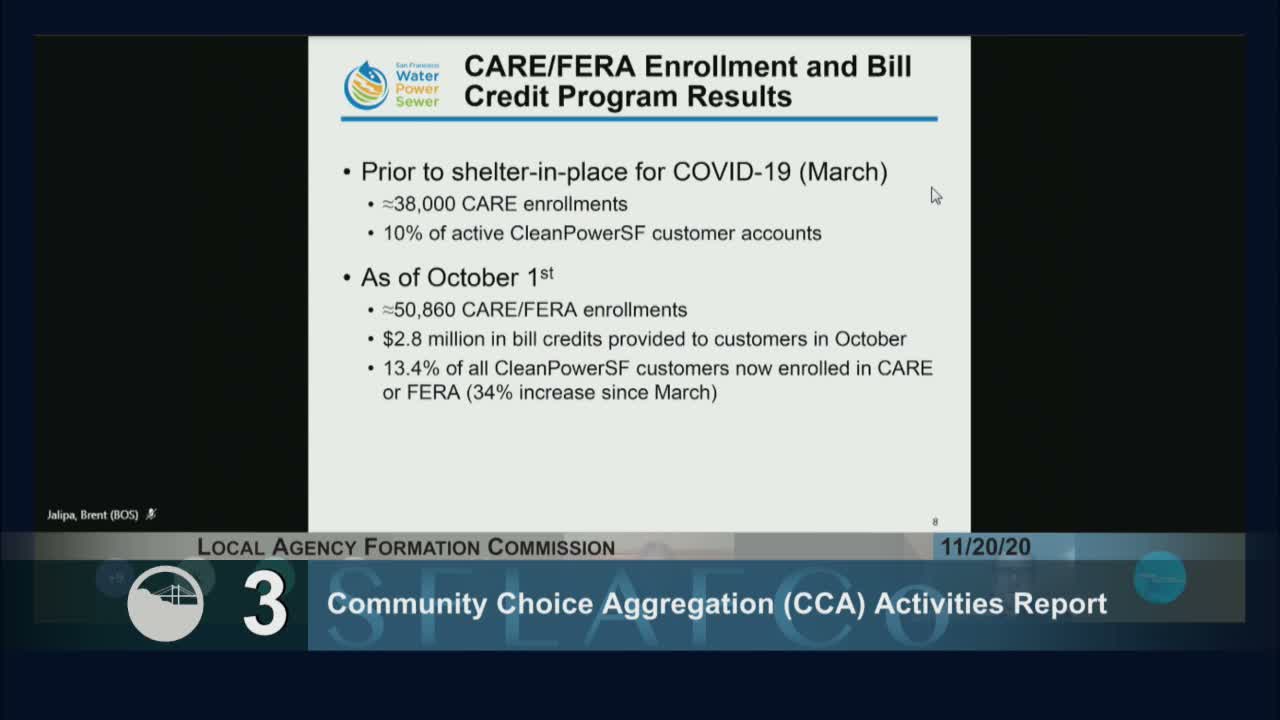
Michael Hyams, Clean Power SF program manager at the San Francisco Public Utilities Commission, told the Local Agency Formation Commission that COVID‑19 has driven higher bill delinquencies among Clean Power SF customers and that low‑income customers have been disproportionately affected. Hyams said SFPUC applied a one‑time bill credit in October to customers enrolled in CARE and FERA and that preliminary analysis shows a 43% reduction in overdue CARE accounts after that credit.
Hyams presented district‑level data showing roughly a quarter of residential Clean Power SF accounts were up to 30 days past due at the mid‑October snapshot, with some districts showing rates near 40%. He said about 8% of accounts were 31–60 days past due and about 6% over 60 days; CARE accounts were overrepresented in the overdue population and Supervisorial District 10 had nearly one in five CARE accounts more than 60 days past due.
Hyams described the statewide Arrearage Management Program (AMP), created by the California Public Utilities Commission under Senate Bill 598, which allows qualifying residential customers to enroll in a 12‑month payment plan with one‑twelfth of past debt forgiven after each monthly payment; forgiveness is capped at $8,000 per customer. He said the CPUC will decide whether AMP debt forgiveness will be recovered through the public purpose program charge (spread across PG&E territory) or whether Clean Power SF would need to self‑fund participation. The CPUC resolution on that question was expected later in the year; Hyams said Clean Power SF planned to bring a participation item to the SFPUC on Dec. 8 so customers could access AMP when it launched.
On broader rate dynamics, Hyams said PG&E had filed an application seeking to collect about $252 million in undercollections through the Power Charge Indifference Adjustment (PCIA). If the CPUC approved a one‑year collection, Hyams said the PCIA could rise by about 1¢ per kilowatt‑hour in 2021 — roughly $3 per month for the typical CCA residential customer — unless the utility is allowed to spread recovery over multiple years. "If the PCIA goes up and PG&E collects more revenue around the PCIA, Clean Power SF charges would need to decline to remain competitive," Hyams said, adding that staff were seeking a 36‑month collection period to reduce bill‑shock in the first year.
Public commenters pressed officials on the PCIA and on PG&E’s customer communications. Ted Holtzman of 350 Bay Area supported the proposed joint procurement and urged continued pressure on the CPUC; Winston Parsons and others queried how much a 1¢/kWh change would affect a household bill and called for locally targeted relief and investments in community resilience.
No formal action was required on the presentation. Hyams said staff would monitor the CPUC resolution on AMP cost recovery and return with required approvals so Clean Power SF customers could enroll promptly when the program launches.