Get Full Government Meeting Transcripts, Videos, & Alerts Forever!
Get email alerts on the On Demand Economy topic
No spam. Unsubscribe anytime.
LAFCO advances five next steps on on‑demand labor study, including delivery‑company permitting and e‑bike work
Summary
LAFCO staff proposed five near‑term steps from a labor survey — researching permits for delivery companies, exploring a worker cooperative, piloting e‑bike support, sustaining communications and refining a delivery‑focused survey — and commissioners broadly supported the approach using foundation funds.
San Francisco — LAFCO on June 19 outlined five priority next steps intended to turn findings from a UC‑Santa Cruz on‑demand labor survey into actionable policy and further research.
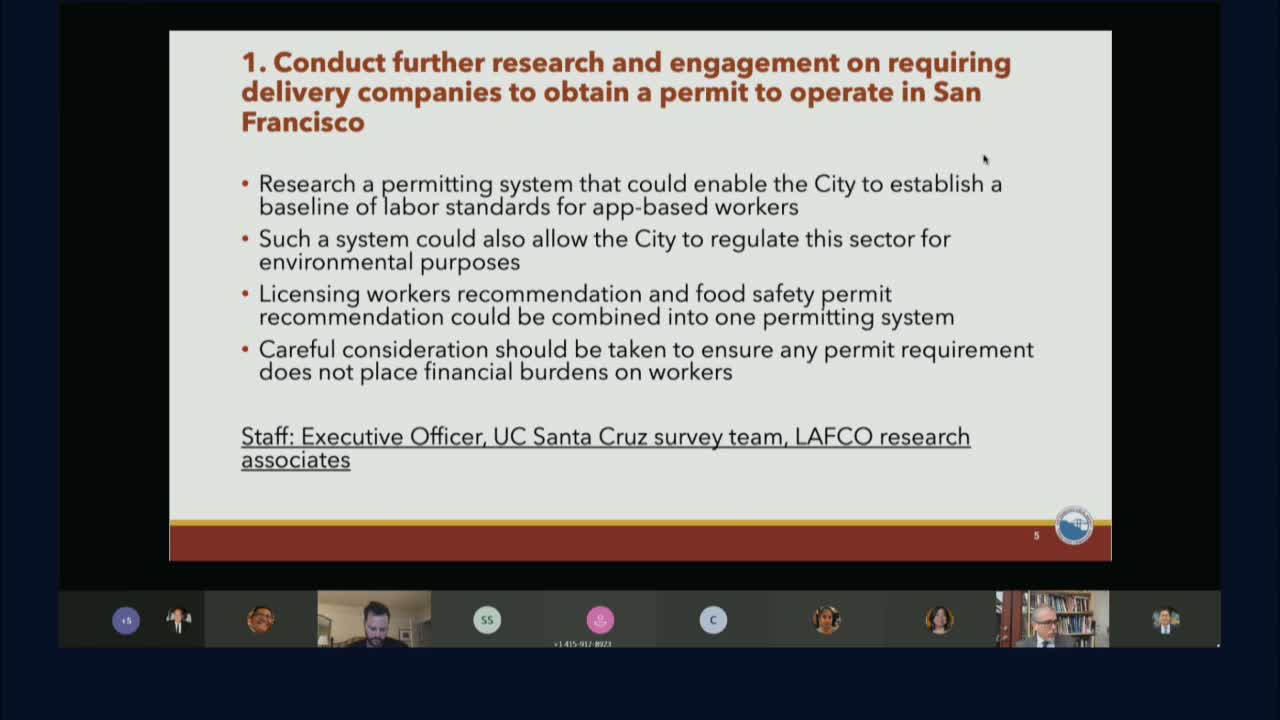
Executive Director Brian Gogel told commissioners the top priority is further research on requiring delivery companies to obtain a city permit to operate, which could attach labor‑law and consumer‑protection conditions. “Of all the recommendations we considered, I think it's possible that this recommendation in particular could have the most immediate effect toward regulating the delivery companies in San Francisco and bringing them into compliance,” Gogel said.
The five recommended steps are: research a delivery‑company permitting model; form a task force to explore a ride‑hail and delivery cooperative; investigate an e‑bike rebate or replacement program; use foundation funds for a two‑month communications push to elevate findings; and expand the survey scope to target delivery workers specifically.
Gogel said the survey work and recommended next steps can proceed largely using existing foundation grants and survey budget carryover; he proposed a possible $45,000 allocation for certain work but said no general‑fund request is required at this stage.
Commissioners endorsed the recommendations and asked for collaboration with other agencies. Commissioner Shanti Singh highlighted co‑benefits from e‑bike programs, including lower vehicle depreciation costs for workers and reduced congestion. Commissioner Courtney Marr asked about enforcement of AB5 and worker resource centers; Gogel said enforcement and resource‑center ideas require additional research and community engagement and could be prioritized later.
The commission directed staff to return with scopes of work, outreach plans and potential partnerships (for example with MTA/SFMTA on e‑bike and congestion questions) and said research associates and interns will support next steps under existing funding.
No vote was required on the recommendations, which will be refined as LAFCO continues stakeholder engagement.