Get Full Government Meeting Transcripts, Videos, & Alerts Forever!
Get email alerts on the Clean Energy topic
No spam. Unsubscribe anytime.
Clean Power SF outlines new renewable contracts, enrollment gains and IRP timeline
Summary
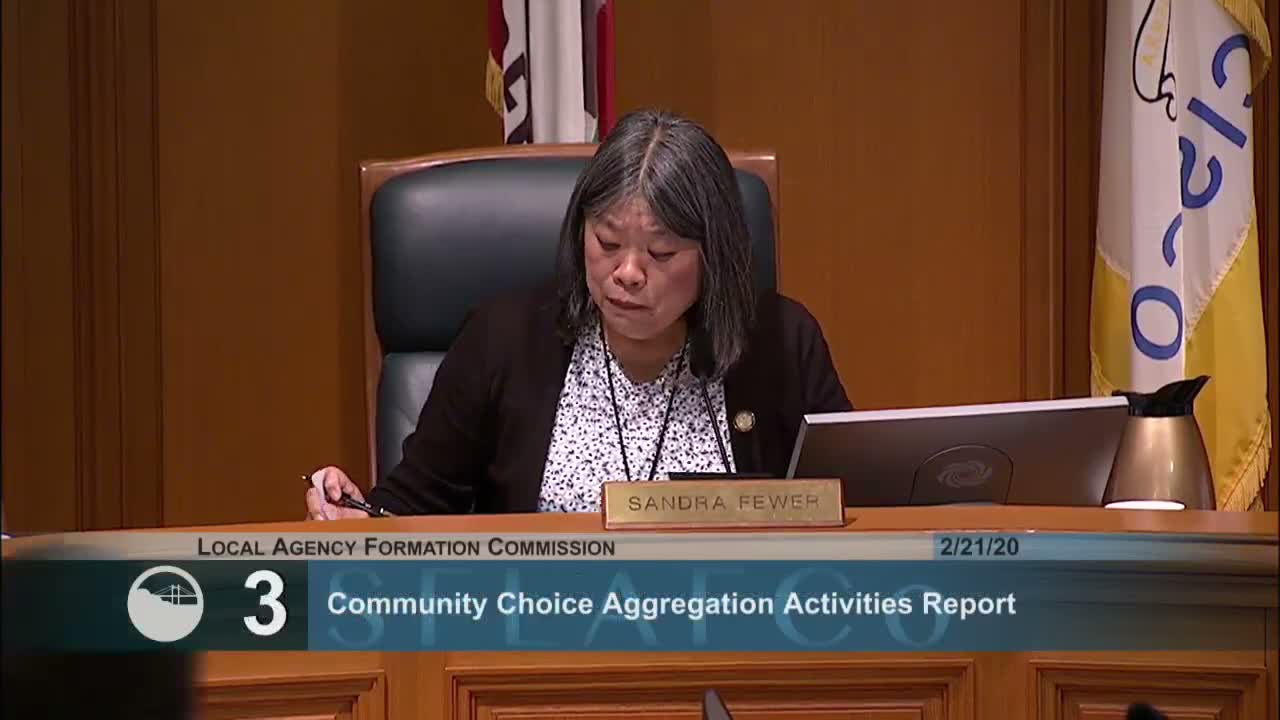
Clean Power SF Director Michael Himes told the San Francisco LAFCO on Feb. 21 that new long‑term contracts will add about 372 MW of renewable capacity and that program enrollment remains strong, while staff prepare a rate action and an Integrated Resource Plan for submission by July 1.
Michael Himes, director of the Clean Power SF program at the San Francisco Public Utilities Commission, told the Local Agency Formation Commission on Feb. 21 that the program is making “steady progress” toward its 2030 renewable goals while managing near‑term rate pressure.
Himes said Clean Power SF’s opt‑out rate has increased slightly to 3.7 percent, yielding more than a 96 percent customer retention rate. Super Green enrollment — an option that supplies 100 percent California RPS‑eligible renewable power — now stands at 2 percent of active accounts and accounts for more than 4.5 percent of the program’s annual sales, he said.
On procurement, Himes described several recently executed long‑term contracts intended to support new renewable projects and repowering. He said the general manager expanded the Voyager 4 wind project commitment from an original 47 megawatts to 110 megawatts and executed a 100‑megawatt contract for the Maverick 6 solar project. Altogether, Himes said, Clean Power SF has four long‑term contracts — each 15 to 22 years in duration — that total about 372 megawatts of new renewable capacity, producing roughly “a million megawatt hours of energy per year,” which he said represents about one‑third of the program’s 2030 supply target at current enrollment.
Himes framed the long‑term purchases as the financing vehicle that enables new project construction and said staff balance those contracts with shorter‑term market purchases. He reported that, in the last completed reporting year, the program’s green product was about 48 percent RPS‑eligible renewable energy.
Himes also described an internal Clean Power SF equity project to embed an equity lens across program policies and business practices. He said LAFCO’s executive officer serves on the project’s steering committee and staff plan stakeholder outreach and a policy framework the commission would consider for approval later in the fiscal year.
On customer rates, Himes warned that changes at Pacific Gas & Electric and the Power Charge Indifference Adjustment (PCIA) are creating near‑term cost pressure. He said the PUC expects a substantial shift: a decrease in PG&E’s generation rates alongside an estimated 20 percent increase in the PCIA that could be implemented as soon as April. Clean Power SF staff estimate that, absent program adjustments, customers would pay about 4 to 6 percent more for generation than they would with PG&E. To address that, Himes said staff will bring a rate action to the commission on Feb. 25 to ensure cost recovery while preserving competitiveness and affordability.
Himes closed with an update on the Clean Power SF Integrated Resource Plan (IRP). The California PUC extended the IRP submission due date from May 1 to July 1 to allow retail sellers time to incorporate forthcoming PUC guidance. Himes said the SFPUC commission is expected to adopt the IRP in late May or June and submit it to the California PUC by the July 1 deadline.
In public comment, Jed Holtzman of 350 Bay Area urged the commission to provide historical PCIA data and criticized the structure that he said effectively charges CCAs for Diablo Canyon capacity. Holtzman also urged a more comprehensive local renewable build‑out plan and said LAFCO should press SFPUC staff with specific questions to accelerate program features that neighboring community choice aggregators have implemented.
The presentation also included a procurement update: staff reported recent solicitations and indicated they are pursuing regional projects and additional short‑ and long‑term purchases as they refine an integrated procurement portfolio.
The commission did not take action on the Clean Power SF update but the presentation precedes a Feb. 25 commission rate action and the IRP work targeted for adoption and submission this spring.