Get Full Government Meeting Transcripts, Videos, & Alerts Forever!
Get email alerts on the Energy Equity topic
No spam. Unsubscribe anytime.
Intern’s equity report spotlights 15,000 annual shutoffs and urges targeted solar‑plus‑storage for vulnerable neighborhoods
Summary
A LAFCO intern presented research finding roughly 15,000 account disconnections annually (2016–2018) and stark neighborhood disparities; the report recommends targeted outreach, solar‑plus‑storage for affordable and senior housing, a single point of contact for efficiency programs, and workforce stipends to improve equity and resilience.
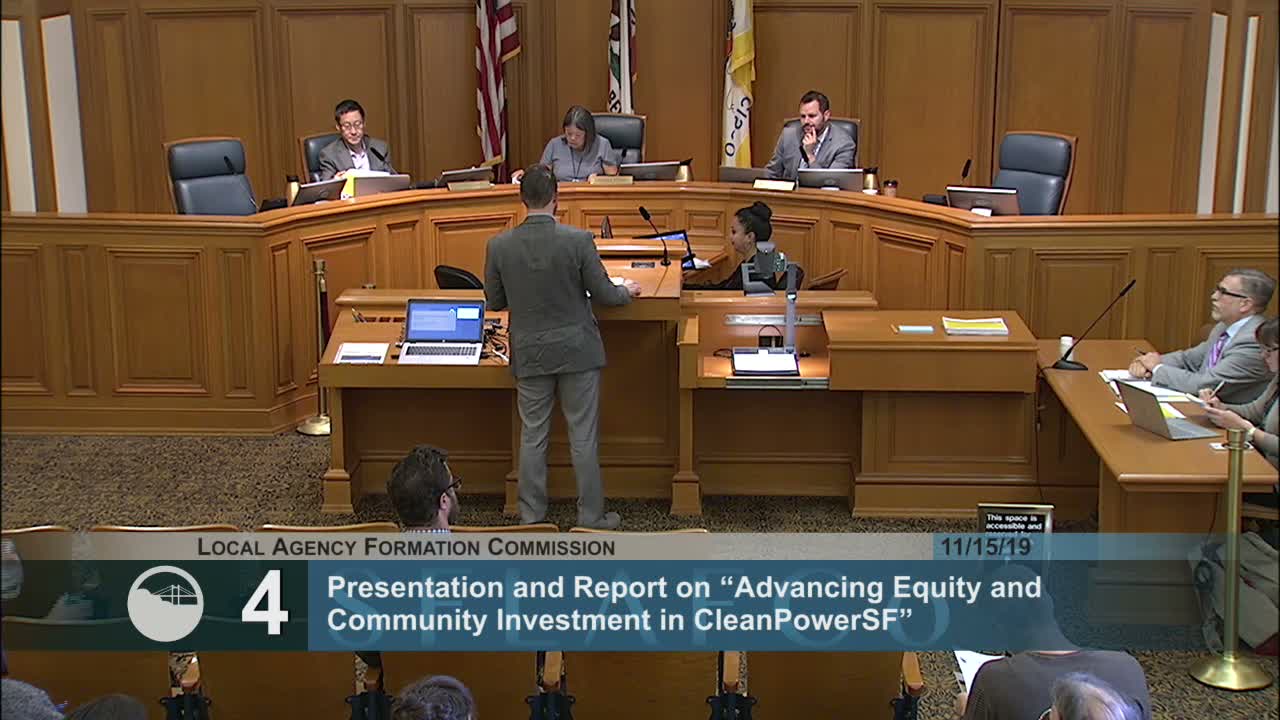
Winston Parsons, a LAFCO intern and graduate student, presented eight months of research to the commission on Nov. 15 aimed at advancing equity in Clean Power SF’s programs. Parsons said his analysis of 2016–2018 data shows roughly 15,000 accounts are disconnected annually in San Francisco, with significant geographic disparities: Bayview–Hunters Point had disconnection rates roughly double the Outer and Central Richmond and 3.5 times higher than West Portal and St. Francis Woods.
Parsons said existing state discount programs such as CARE are not eliminating disconnections in the city and that the income eligibility thresholds do not reflect San Francisco’s local cost of living. He described the disconnection process as confusing for customers — with letters from both Clean Power SF and PG&E — and noted that when customers are removed from Clean Power SF for nonpayment they may face variable energy rates later.
Key recommendations in Parsons’ report included: focused outreach and programming in high‑disconnection neighborhoods; developing solar‑plus‑storage (resilient solar) projects for affordable and senior housing to provide backup power during outages and to pass bill savings to residents; establishing a one‑stop shop to streamline energy efficiency programs; formalizing the waiver or elimination of involuntary return fees; and funding workforce development with stipends to retain trainees.
Parsons also recommended formal city goals and regular reporting on disconnection disparities, better data sharing with PG&E to measure outage durations, and cross‑departmental collaboration to ensure programs reach undocumented populations and avoid displacement effects.
Commissioners praised the report’s breadth, asked for demographic overlays and duration data (who is affected and for how long), and urged the equity working group and Clean Power SF staff to vet the recommendations and scope next steps. Parsons noted a small number of pilot resilient projects exist (e.g., Thurgood Marshall High) but that broader piloting and funding would be needed to scale resiliency for housing.
Ending: The commission did not take action but asked staff and the equity working group to review the recommendations and return with feasibility, scope, and potential timelines as part of future planning for Clean Power SF programs.