Get Full Government Meeting Transcripts, Videos, & Alerts Forever!
Get email alerts on the Energy Equity topic
No spam. Unsubscribe anytime.
LAFCO asks for consultant support to analyze energy equity, pilot legislation and provide technical review of Clean Power SF projects
Summary
LAFCO proposed hiring renewable energy consultants to deepen analysis of energy disconnections, propose pilot legislation for solar-plus-storage at affordable/senior housing, strengthen oversight of Clean Power SF project proposals, and evaluate workforce development gaps; no formal action was taken.
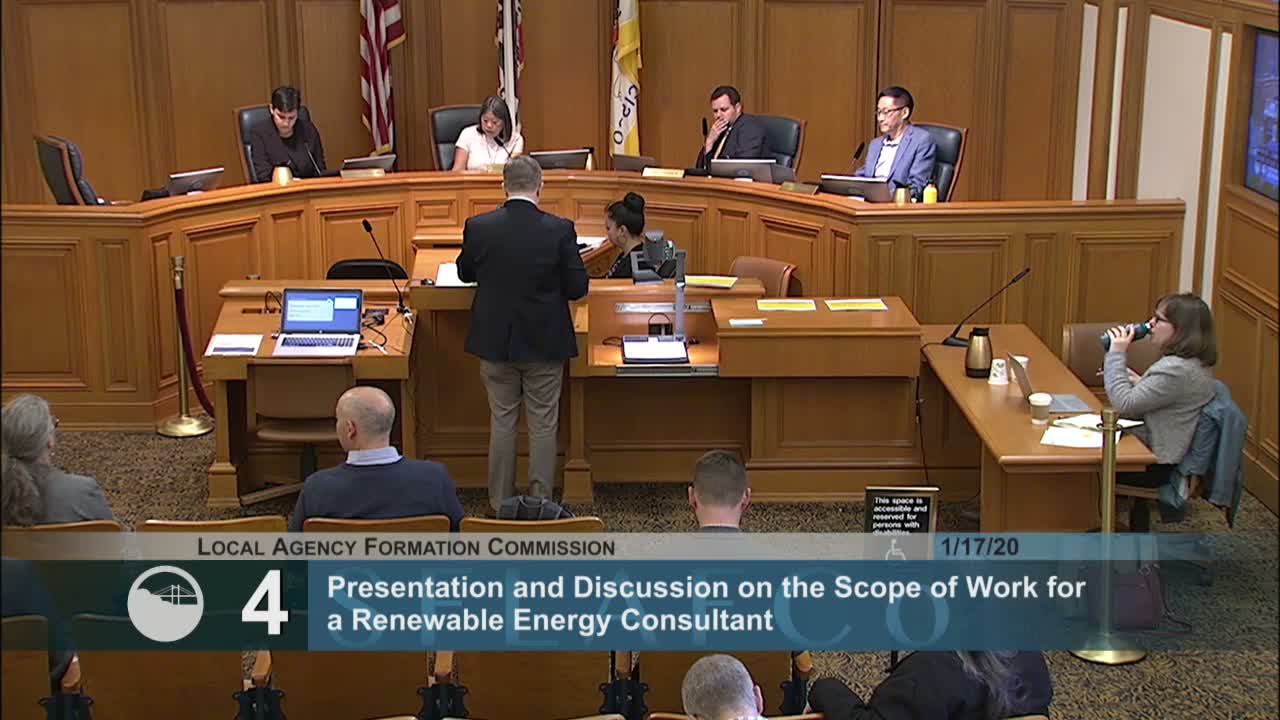
Brian Gobel, LAFCO executive officer, asked the commission to consider a scope of work for renewable energy consultants that would supplement Clean Power SF analysis and strengthen LAFCO's review capacity. Gobel said the consultant work would follow findings from a separate analysis by Winston Parsons on energy equity.
Gobel summarized Parsons' findings: the pilot analysis identified more than 15,000 annual electrical disconnections for nonpayment and significant geographic disparities — some neighborhoods have roughly 3.5 times the disconnection rate of others. Gobel said some dataset errors flagged by CPUC will be corrected and the consultant will perform deeper analysis into drivers of disconnection, including affordability, language barriers and access issues.
The executive officer presented four recommended consultant tasks: (1) further analyze disconnection patterns and causes; (2) provide technical feedback to the SFPUC and LAFCO on Clean Power SF project proposals; (3) explore pilot legislation for solar plus storage at affordable and senior housing sites to protect energy‑dependent populations; and (4) study gaps in the clean energy workforce and propose ways to make training programs more equitable.
Public commenters reiterated calls for a comprehensive build‑out plan and greater funding for city‑level planning. Commissioners sought clarification on consultant scope, whether organized labor would be consulted on workforce work (Gobel confirmed unions would be engaged), and how a consultant could help LAFCO scope a possible larger build‑out study if the commission chooses to take that direction. The commission did not take action on a consultant contract at the meeting and asked staff to return with cost and procurement details.