Get Full Government Meeting Transcripts, Videos, & Alerts Forever!
Get email alerts on the Clean Power Sf topic
No spam. Unsubscribe anytime.
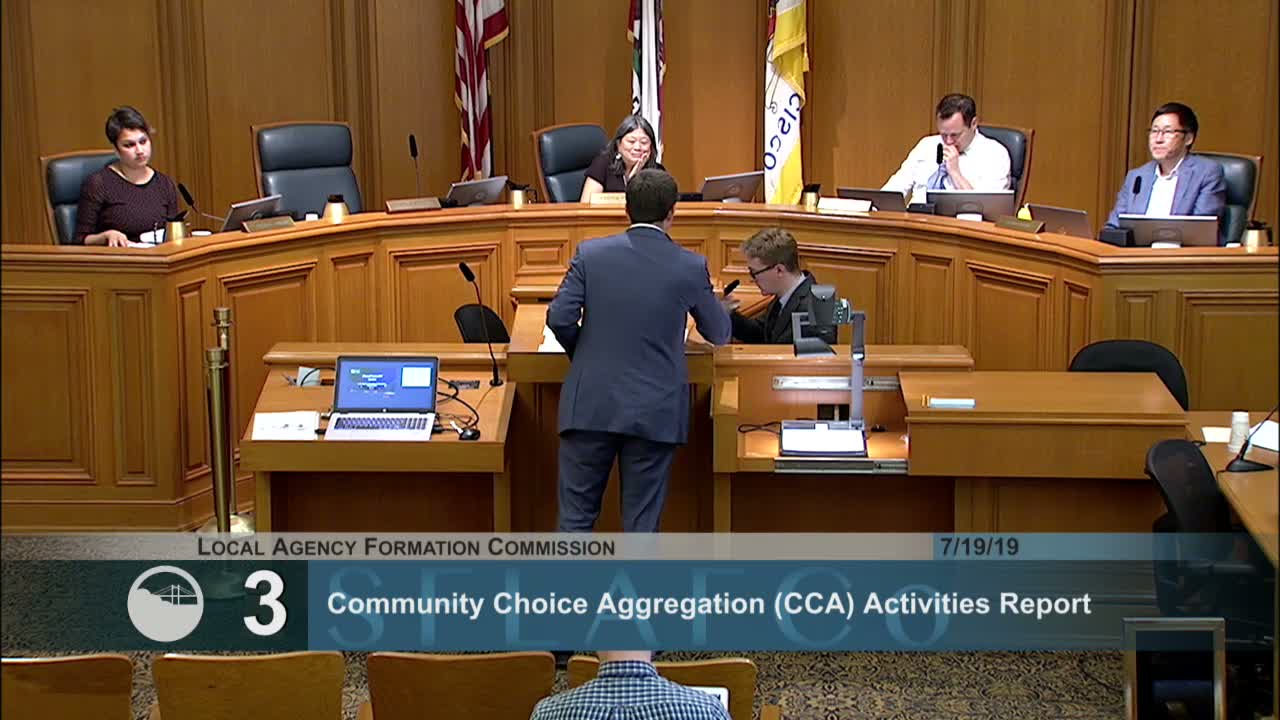
LAFCO hears Clean Power SF report: more than 400,000 accounts enrolled, staff warn state bills could complicate public-power options
Summary
Clean Power SF staff told the San Francisco Local Agency Formation Commission that the city enrolled over 400,000 accounts with low opt-out rates and expanding renewable purchases, while SFPUC policy staff and public commenters warned that recent state legislation (including AB 1054) could complicate municipalization or acquisitions of investor-owned utility assets.
Michael Himes, director of Clean Power SF at the San Francisco Public Utilities Commission, told the San Francisco Local Agency Formation Commission on July 19 that Clean Power SF has enrolled more than 400,000 customer accounts and sustained a 3.4 percent opt-out rate. He said the program's "Super Green" 100-percent renewable upgrade has 1.6 percent uptake, about 6,200 accounts, and that program demand rose from roughly 63 megawatts to 240 megawatts on average during the past fiscal year.
Himes said Clean Power SF expects about 340 megawatts of average sales for the current fiscal year and that the program's energy portfolio will be at least 50 percent California-certified renewable this year. He said the commission has had to increase renewable energy purchases by roughly 300 percent to support the expanded enrollment and that citywide electric-sector greenhouse-gas emissions are now estimated to be 80 percent below 1990 levels, an effect the PUC equated to taking about 92,000 passenger vehicles off the road for a year.
The presentation placed Clean Power SF planning in the context of the city's 10-year capital plan. Heather Green, director of capital planning and the city's deputy resilience officer, described a constrained 10-year plan that documents $39 billion in planned investments, an $800 million general-fund backlog in facilities, and the roles of enterprise departments (airport, port, MTA, PUC) in the capital budget. Green said the capital plan's funding principles prioritize legal mandates and life-safety work, and that the plan informs the timing and mix of one-time and debt-funded investments.
Suzanne Mirckelson of the SFPUC's policy and government affairs team briefed the commission on state legislation that could affect Clean Power SF and any future municipalization efforts. She said AB 56 (a proposal to designate a central buyer for procurement) failed to advance this year and will carry over as a two-year bill; SB 155 (which would expand CPUC review and oversight of integrated resource plans) has been the subject of negotiated compromise language; and AB 1054, signed as an urgency wildfire and utility financial-stability bill, took effect immediately and includes late amendments that broaden CPUC authority over public entities seeking to acquire investor-owned utility assets.
Mirckelson said those late amendments make acquisition of PG&E assets within the city more difficult and noted the mayor's office is engaging with the governor's office about the provisions. Commissioners and staff stressed that urgency legislation takes effect immediately but can be amended in later sessions; Mirckelson said SFPUC and the mayor's office plan to continue engagement and that CalCCA and other stakeholders are actively involved.
Public commenters urged a more aggressive, city-driven local-buildout plan for renewables and storage. Eric Brooks of San Francisco Clean Energy Advocates and Californians for Energy Choice said the SFPUC's enterprise approach is conservative and insufficient for the rapid local buildout activists say is needed; he argued the Board of Supervisors should lead citywide planning and hire outside contractors promptly. Jed Holtzman of 350 Bay Area urged gap analysis between current funding levels and the resources needed for a large local buildout, and he pressed for financing options for building decarbonization in existing, lower-income housing.
The most immediate next steps noted at the meeting: Clean Power SF will develop its own capital plan for the program in the upcoming budget cycle, the SFPUC will produce an 11-year integrated resource plan due next spring that will model scenarios through 2030, and staff will continue stakeholder engagement on legislative issues. The commission did not take formal action on the Clean Power SF presentation.
Ending: The commission closed the item after public comment and will continue oversight at upcoming meetings; staff said additional details on the Clean Power SF capital plan and integrated resource plan will be available over the next six months.