Get Full Government Meeting Transcripts, Videos, & Alerts Forever!
Get email alerts on the Clean Power Sf topic
No spam. Unsubscribe anytime.
Clean Power SF reports high retention, launches budget‑billing pilot and readies IRP to CPUC
Summary
Clean Power SF told LAFCO it has a 3.6% opt‑out rate (over 96% retention), a 1.8% super‑green upgrade rate (about 6,800 accounts), and is piloting a new optional budget‑billing program to flatten seasonal bills. Staff also outlined two pending rate actions and an integrated resource plan due to the California PUC in spring 2020.
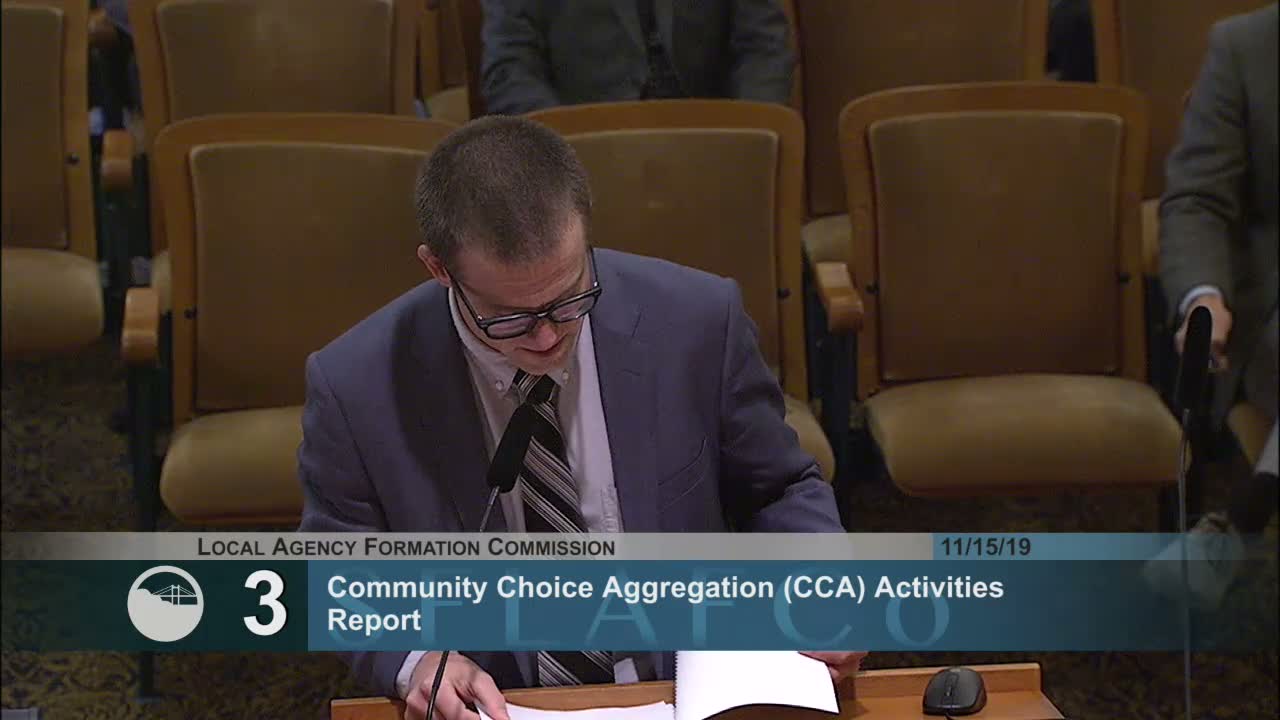
Michael Himes, director of Clean Power staff for the San Francisco Public Utilities Commission, told the San Francisco Local Agency Formation Commission on Nov. 15 that Clean Power SF is maintaining strong customer retention while rolling out new programs and planning documents.
Himes said the program’s opt‑out percentage is currently 3.6%, giving a retention rate above 96%, and that the super‑green upgrade rate — customers that opt for 100% renewable supply — is about 1.8%, representing more than 6,800 accounts; about 500 accounts upgraded since August. He announced Clean Power SF was one of seven global winners of a C40/Bloomberg Philanthropies climate action award and noted the award carried no monetary prize.
The agency is testing a new optional budget‑billing program intended to reduce seasonal volatility in monthly bills by billing participating customers based on an average of the previous 12 months’ usage. “Under budget billing, participating customers will be billed based on an average of the past 12 months of customer usage to estimate a levelized bill,” Himes said. He said a soft launch and back‑end testing are underway with contractor Calpine Energy Solutions; broader marketing is planned for January.
Himes also previewed two near‑term rate efforts: responding to expected changes in PG&E’s generation rates and the Power Charge Indifference Adjustment (PCIA, often called the exit fee), and proposing a rate action to address the state’s transition to default time‑of‑use rates for residential customers. He said those changes could require Clean Power SF to adjust its own rates to remain competitive.
On long‑term planning, Himes said Clean Power SF is preparing a second biennial integrated resource plan (IRP) and a renewable energy plan. The IRP, which forecasts customer demand over 20 years and evaluates resource portfolios, will be submitted to the California Public Utilities Commission for certification in spring 2020. A draft renewable energy plan will be delivered to the SFPUC next month and a capital plan tied to Clean Power SF’s local build‑out is scheduled for SFPUC commission review in January 2020 and board consideration by June 2020.
No action was required of LAFCO on the report; commissioners welcomed the metrics and said they looked forward to more detailed IRP and rate proposals in early 2020.
Ending: Clean Power SF will continue testing the budget‑billing pilot over the winter, present proposed rate changes and the IRP schedule to LAFCO at future meetings, and provide program materials and drafts for review as they become available.