Get Full Government Meeting Transcripts, Videos, & Alerts Forever!
Get email alerts on the Gig Economy Labor Study topic
No spam. Unsubscribe anytime.
University of San Francisco students present preliminary gig‑worker study to LAFCO
Summary
Graduate students presented preliminary findings from a University of San Francisco labor study on transportation network company (TNC) drivers, reporting a small sample (36 survey respondents, six interviews) that showed long hours, concerns about pay and safety, and recommendations including congestion pricing, curb management and exploring support for AB5.
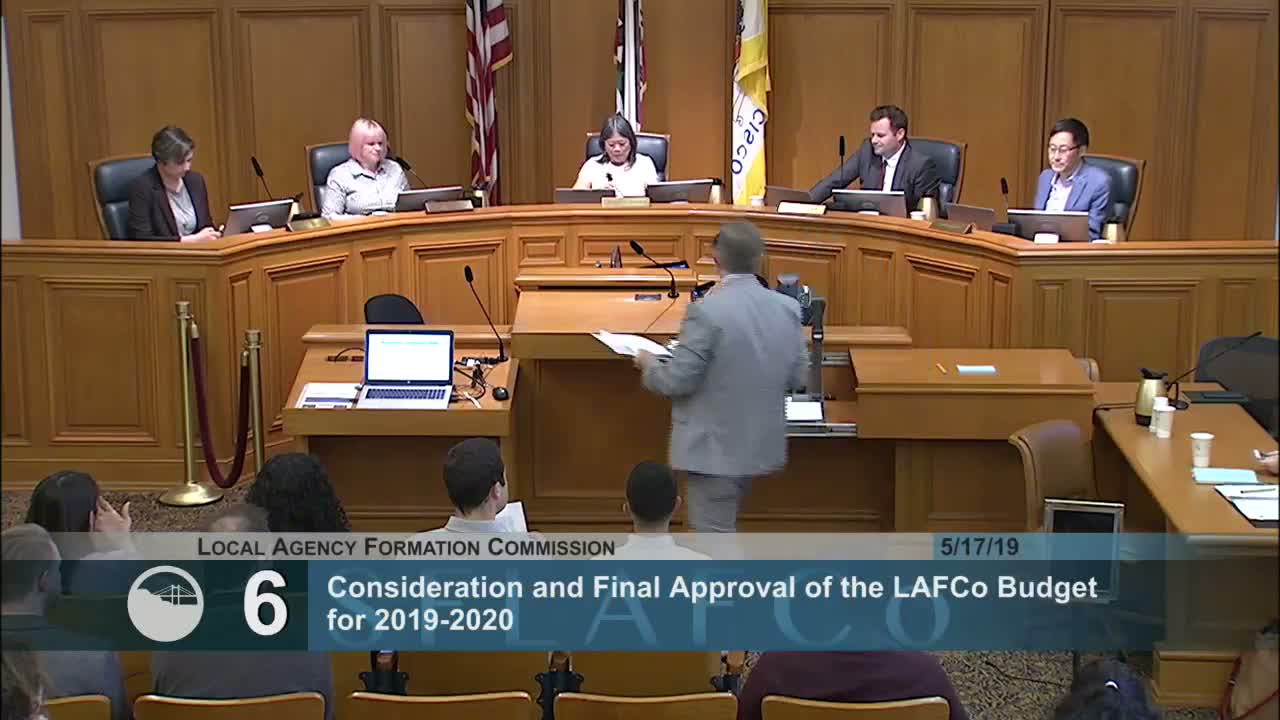
Graduate students from the University of San Francisco on May 17 presented preliminary findings from a semester‑long labor study of on‑demand workers to the Local Agency Formation Commission (LAFCO), describing labor, geographic and policy patterns that they say merit deeper investigation.
The class, introduced by Professor Diane Inagran, split research into four teams — labor, political economy, geography and best practices — and used a mix of an online survey, in‑person interviews and mapping tools. Sergio Martinez, a member of the labor team, said the survey produced 36 responses and six follow‑up interviews.
"We found that over two thirds of respondents strive for both Uber and Lyft," Martinez said, summarizing a recurring pattern that many drivers use multiple apps. The students reported that many drivers work more than 40 hours a week when combining platforms and that two‑thirds did not view driving as a long‑term career.
Key findings the students highlighted included income and expense uncertainty (three‑quarters of respondents said pay from Uber/Lyft is unfair), negative physical health impacts reported by over three‑quarters of respondents, and significant safety concerns: 47 percent reported feeling unsafe while driving compared with 26 percent who reported feeling safe. The geography team, led by Justin Pearson, said many respondents live outside San Francisco — in Alameda, Contra Costa and Santa Clara counties or farther — and that some drivers reported daily distances commonly around 100 miles and occasionally above 250 miles.
The best‑practices team offered six policy recommendations. Winston Parsons urged consideration of congestion pricing tied to reinvestment in transit; he also recommended a comprehensive curb‑management strategy to reduce illegal parking and improve traffic flow. Preston Kilgore said driver safety was often overlooked in existing regulation and urged that the Department of Public Health and local policymakers examine options for regulating delivery operators and improving reporting and recourse for drivers.
On labor status, the students urged caution but recommended that the city consider formal action in support of AB5, Assemblymember Lorena Gonzalez’s bill that enshrines the ABC test used to evaluate employee versus contractor status. "The contractor status is currently being abused, and we think the city should consider supporting worker protections as soon as possible," Parsons said.
Commissioners thanked the students and pressed on limits and next steps. Chair Sandra Lee Feuer and Commissioner Pollock asked about the small sample size and whether the students could collect more rigorous data in partnership with LAFCO and the Jobs with Justice survey effort. The students acknowledged the sample’s limits and recommended follow‑up work and more detailed questions — for example, on debt, vehicle lease terms and net hourly take‑home pay after expenses.
Public commenters praised the research while raising other concerns: one speaker urged the students and commissioners to study medallion disparities and race‑based impacts; another suggested exploring city‑level technological or financial tools, such as a public currency, to change market structures.
LAFCO commissioners said the presentation was a useful initial diagnosis and encouraged the students and staff to continue working with LAFCO on a larger, more representative survey.
The commission did not take formal action on the student study during the meeting; commissioners indicated interest in follow‑up and in coordinating with the Jobs with Justice Education Fund survey that LAFCO separately approved funding for earlier in the agenda.