Get Full Government Meeting Transcripts, Videos, & Alerts Forever!
Get email alerts on the Municipalization topic
No spam. Unsubscribe anytime.
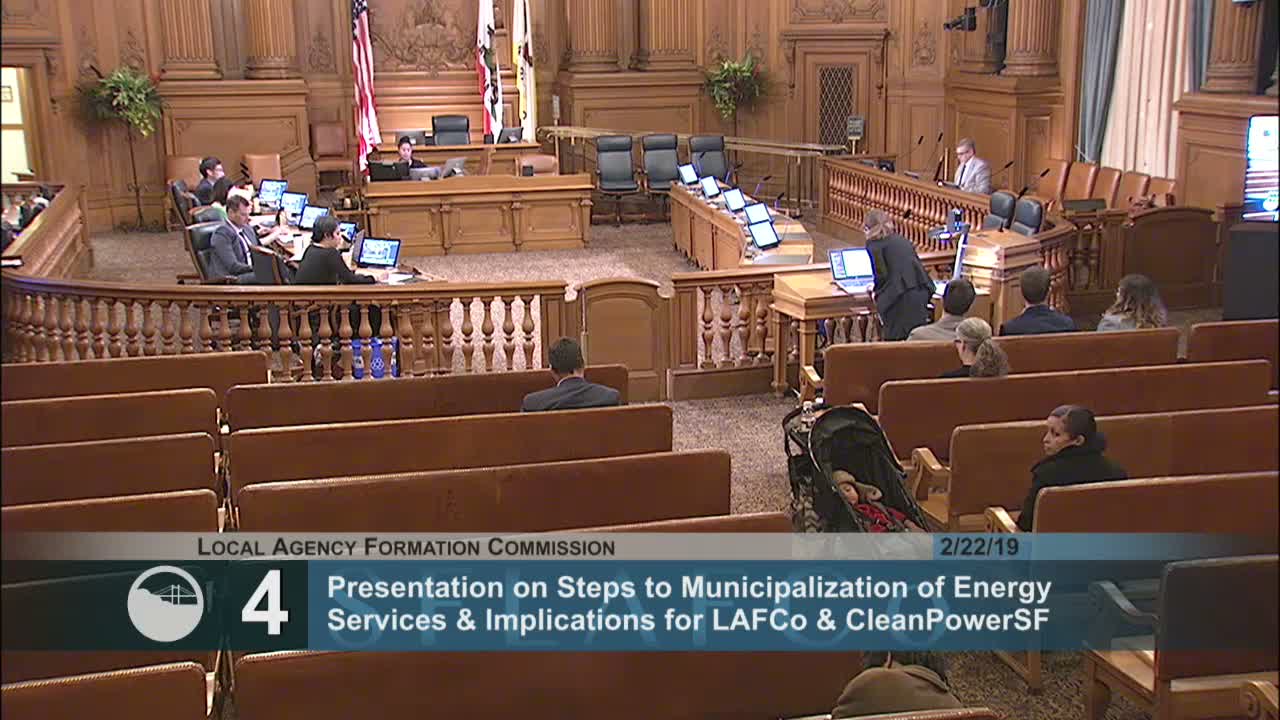
LAFCO legal counsel reviews municipalization options, eminent-domain constraints during PG&E bankruptcy
Summary
LAFCO general counsel Inder Kalsa outlined how a municipal utility differs from a municipal utility district, LAFCO's statutory role, acquisition routes (construct, negotiate, condemnation) and how PG&E's bankruptcy could limit acquisition of assets through eminent domain.
Inder Kalsa, general counsel for San Francisco LAFCO, gave a legal primer on Feb. 22 describing options and constraints for municipalizing energy services.
Kalsa explained that a municipal electric utility is a city-operated utility that functions inside municipal boundaries, while a municipal utility district (MUD) is a separate governmental agency that can operate beyond a single city and requires voter approval. "There is no statutory role for the San Francisco LAFCO in overseeing a municipal electric utility," Kalsa said, "however such a role could be defined by the board of supervisors similarly to how the board assigned oversight for Clean Power SF."
On acquiring distribution infrastructure, Kalsa listed three options: construct new infrastructure, negotiate a sale or transfer with the incumbent utility (PG&E) or use condemnation (eminent domain). He cautioned that while PG&E is in bankruptcy, sale or eminent-domain approaches may be constrained because the bankruptcy court seeks to preserve PG&E's assets as value for creditors. "Once you're in the bankruptcy court, the bankruptcy court can prevent anyone from suing the subject of the bankruptcy," Kalsa said.
Kalsa also noted legal and practical hurdles to eminent domain: a two-thirds vote of the governing body for a resolution of necessity, payment of just compensation and difficulties valuing unique utility infrastructure. He said valuation could be determined through superior-court proceedings or with CPUC involvement.
Commissioners asked for examples; staff and counsel cited SMUD, LADWP, Palo Alto and other municipal utilities as comparators and said San Francisco's Hetch Hetchy system already provides 100 percent greenhouse-gas-free electricity for a portion of city load.
No commission action followed; staff offered to research historical municipalization examples and to supply feasibility and valuation work conducted under city direction.