Get Full Government Meeting Transcripts, Videos, & Alerts Forever!
Get email alerts on the Clean Power Sf topic
No spam. Unsubscribe anytime.
Clean Power SF reports near‑citywide enrollment; SFPUC flags state bills that could affect CCAs
Summary
Clean Power SF told the Local Agency Formation Commission it has enrolled roughly 400,000 customer accounts (about 99.9% of potential accounts), with a 2.7% opt‑out rate; SFPUC staff warned pending state legislation (including AB 56 and SB 155) could change procurement and oversight rules for community choice aggregators.
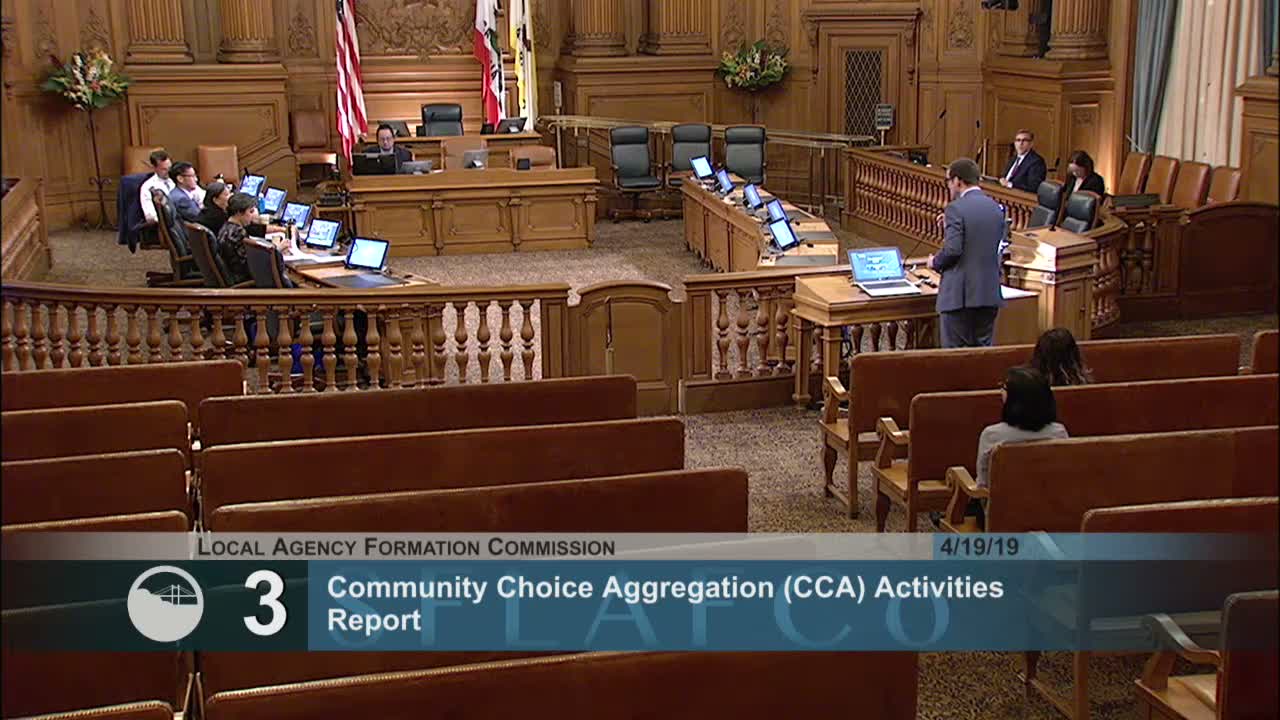
Michael Hyams, director of Clean Power SF at the San Francisco Public Utilities Commission, told the San Francisco Local Agency Formation Commission in April 2019 that Clean Power SF has completed enrollment of the city’s residential accounts and, as of April, has enrolled more than 400,000 customer accounts — about 99.9% of potential accounts. "The cumulative opt‑out rate for the program is now 2.7%," Hyams said, and the Super Green upgrade rate stands at 1.4%. Hyams emphasized that percentage rates change as the number of enrolled accounts grows but that "a lot of sales" ultimately drives climate impact.
Hyams compared the program’s voluntary Super Green upgrades with peers, saying the multi‑county Marin CCA (MCE) posts about a 1.9% upgrade rate and Sonoma’s CCA is around 1%; Clean Power SF’s internal goal for Super Green upgrades is 5%. Hyams said some of the largest commercial accounts remain to be enrolled later in the year and that the program remains in open enrollment, so opt‑out and upgrade figures may change.
Suzanne Merkelson of the SFPUC’s policy and government affairs team briefed the commission on a recent report from the governor’s wildfire strike force and summarized state bills the SFPUC is monitoring. Merkelson said the strike force report focuses on wildfire prevention and response, preserving the state’s clean‑energy progress, and making the California Public Utilities Commission (CPUC) more effective. She listed five priority areas in the report and said several recommendations could surface in upcoming legislation.
On specific bills, Merkelson said the SFPUC is opposed to AB 56 — legislation that, as drafted, would give the CPUC the authority to task an existing state agency to act as a procurement backstop. She also identified AB 1362 as a bill CalCCA opposes because it would overturn a 2011 law (SB 790) that constrained investor‑owned utilities’ marketing against CCAs; and she said SB 155, which would allow the CPUC to audit load‑serving entities’ compliance with renewable portfolio rules, was under review and raised autonomy and cost concerns for CCAs.
Merkelson told commissioners the SFPUC and CalCCA will be engaging in Sacramento on amendments and that some bills are expected to be amended to address stakeholder concerns. No commission action was required on the presentation.
The commission did not receive public speakers on this item and Hyams and Merkelson answered no substantive public objections at the meeting. The SFPUC presentation closed with the commission noting the information and requesting continuing updates as legislation progresses.