Get Full Government Meeting Transcripts, Videos, & Alerts Forever!
Get email alerts on the Clean Power Sf topic
No spam. Unsubscribe anytime.
Clean Power SF outlines local build‑out, enrolment and contracts as commissioners press municipalization questions
Summary
Clean Power SF presented its Integrated Resource Plan, local procurement strategy and April citywide enrollment of 280,000 accounts, and described long‑term contracts and feed‑in approaches; commissioners probed site feasibility, funding, bond timing and the implications of PG&E’s bankruptcy for municipalization.
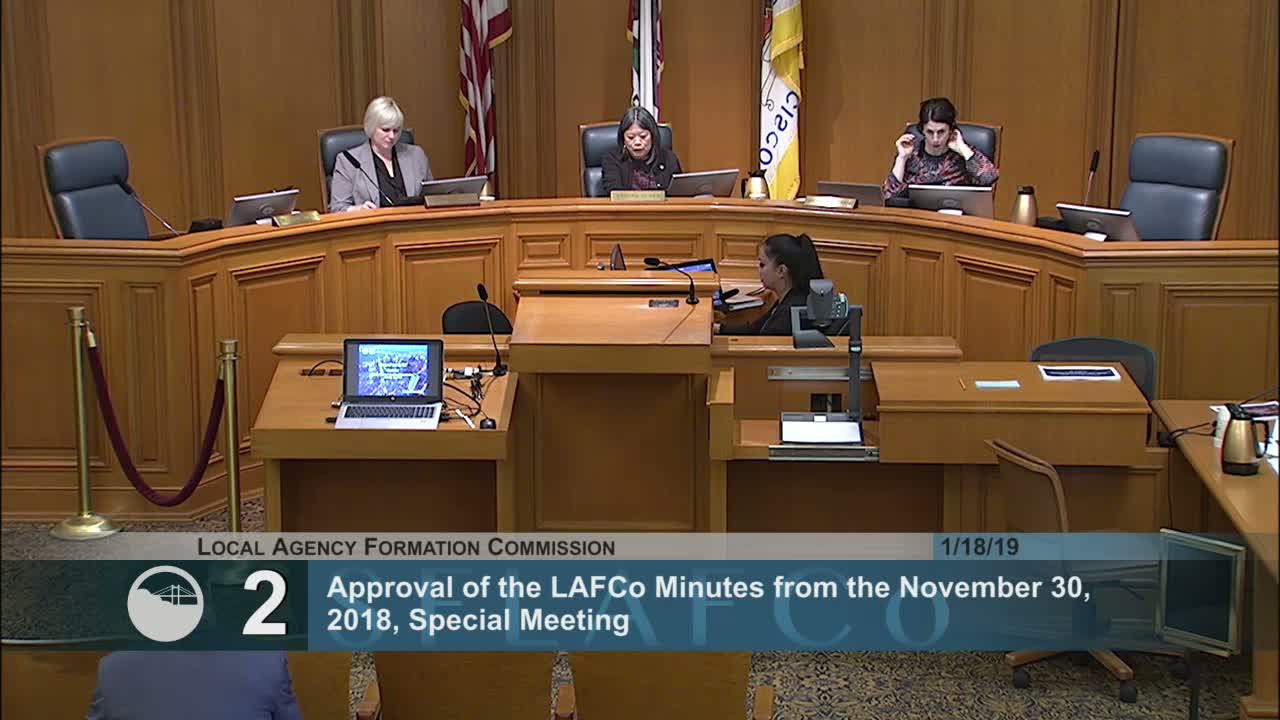
Michael Himes, director of Clean Power SF at the San Francisco Public Utilities Commission, told the Local Agency Formation Commission on Jan. 18 that Clean Power SF is advancing a local build‑out strategy while preparing for April citywide enrollment.
Himes said the program has executed short‑ and long‑term agreements to secure renewable supply and meet regulatory obligations. He cited purchases from the Sunset Reservoir solar project, wind energy from the Shiloh 1 wind farm and the Geysers geothermal deliveries under a five‑year Calpine contract that includes community‑benefit provisions. Himes said two long‑term contracts — a 100‑megawatt solar project in Lancaster and a 47‑megawatt wind repower in Mojave — are expected to begin deliveries in 2019–2020. Combined, those projects are projected to supply roughly 130,000 average San Francisco households and support about 600 construction and operations jobs in California.
Himes described Clean Power SF’s local‑investment approach as twofold: supply‑side acquisition of renewable generation (with a preference for projects in the nine‑county Bay Area) and demand‑side measures to reduce customer energy use within the city. He previewed a proposed feed‑in tariff for targeted procurement on city‑owned property — a standard contract with a fixed price intended to spur rooftop and other local projects — and the intent to issue Bay Area renewable solicitations in March.
On program performance, Himes presented an Integrated Resource Plan (IRP) prepared under state law and required to be updated biennially. He said Clean Power SF’s portfolio has produced lower average carbon emissions per megawatt hour than PG&E’s comparable products since service began in 2016, and noted year‑to‑year variation driven by hydro availability and program growth. Himes also highlighted battery storage as a critical technology examined in recent IRP cases.
Enrollment and regulatory steps: Himes said the program will enroll approximately 280,000 accounts in April — more than twice the number currently served — and that staff must finalize a rate change hearing outcome and deliver four statutorily required notices across a four‑month period straddling the April enrollment.
Commissioners pressed staff on several practical and policy points. Commissioner Cynthia Pollock asked about priority sites reported in prior studies (including the SFO parking lot and Hunters Point Parcel E) and whether they are shovel‑ready; Himes said additional feasibility and engineering work and coordination with controlling entities (for example the airport) would be needed to prepare RFPs. Pollock also asked whether early planning work is budgeted; Himes said planning is covered under professional‑services contracts but that site‑specific work would require further feasibility funding.
Commissioner Shanti Singh and others queried how Clean Power SF differs operationally and financially from the SFPUC’s Hetch Hetchy power enterprise. Barbara Hale, assistant general manager for power, said both programs are part of the SFPUC power enterprise but must keep separate ratepayer accounts and budgets. She described shared staffing and the ability to transact between programs by contract, but stressed that funds cannot be commingled and noted that the Hetch Hetchy side currently has the established credit rating and bonding capacity that Clean Power SF would need to obtain to access similar finance options.
On municipalization and PG&E bankruptcy: commissioners raised the recent PG&E bankruptcy as a factor accelerating interest in municipalization. Himes and Hale said state law allows municipal utilities and that municipalization would involve a transition in which Hetch Hetchy could absorb Clean Power SF customers and commitments, but they cautioned that the statutory and financial mechanics are complex. Himes said the PUC finance team envisions a possible timeline of roughly three years after stabilization of citywide enrollment to pursue revenue bonds for Clean Power SF, though experience varies across CCAs.
Public comment and local planning: commenters urged a citywide renewable‑build‑out plan led by the Board of Supervisors and LAFCO, and cautioned against rushing municipalization without a stepwise build‑out that prioritizes developing local clean energy resources.
What happens next: Clean Power SF identified near‑term actions — finalize the April enrollment notices, issue Bay Area solicitations in March, and begin capital‑planning work in the fourth quarter of the fiscal year. Staff said they will return with further details to LAFCO and the joint SFPUC‑LAFCO meeting planned for mid‑March.
Ending: The presentation concluded with commissioners requesting follow‑up on site feasibility, bonding models and how the PUC’s capital planning will reflect local build‑out proposals.