Get Full Government Meeting Transcripts, Videos, & Alerts Forever!
Get email alerts on the Taxi Medallion Reform topic
No spam. Unsubscribe anytime.
SFMTA outlines medallion reforms; hundreds of taxi drivers urge city buyback or relief
Summary
SFMTA Director of Taxi and Accessible Services presented draft medallion reforms including limiting SFO pickups to purchased medallion holders and opening the buyer market; an extensive public comment period followed with many drivers urging a city buyback, price cuts or stronger regulation of ride-hail companies.
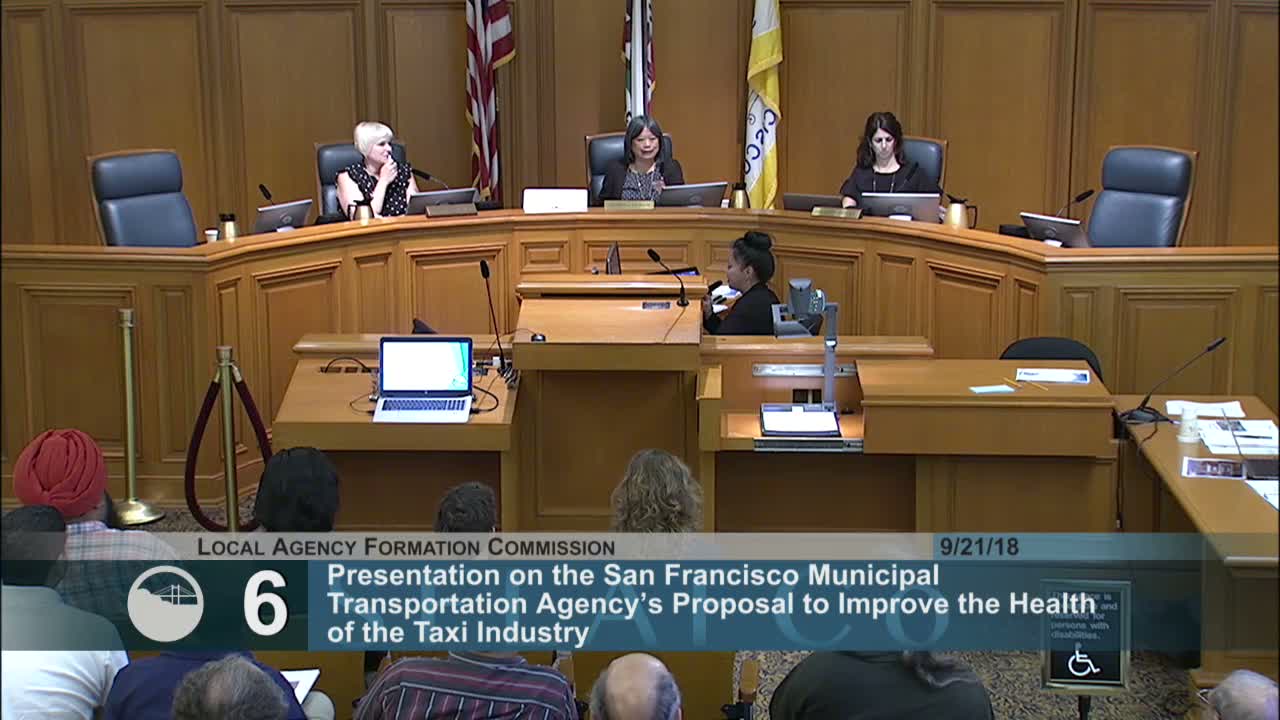
Kate Turan, director of Taxi and Accessible Services at the San Francisco Municipal Transportation Agency, presented a multi-part package of draft recommendations on Sept. 21 intended to stabilize the city’s taxi industry and protect purchased medallion holders.
Turan summarized the industry’s structure and history, described several categories of medallions and reported that the city currently has about 1,400 medallions in service and roughly 5,000 active taxi drivers. She said SFMTA now operates multiple medallion classes — corporate, pre‑Prop‑K, post‑Prop‑K and purchased medallions — and noted additional leased “8,000-series” medallions the agency holds and leases to taxi companies.
Turan presented draft staff recommendations the SFMTA plans to take to its board later this fall. The package included proposals to restrict airport (SFO) curb pickups to purchased medallion holders (with an exemption for wheelchair‑accessible ramp taxis to protect accessibility), to open the buyer market so that business entities can hold medallions (initially proposing limits such as 50 medallions per entity), to eliminate a 5 percent retransfer fee on medallion sales, to consider nonrenewal of corporate and pre‑K medallions and to expand incentives for wheelchair‑accessible vehicles including a subsidy (up to $600 per month) to support ramp taxis.
Turan framed the proposals as an effort to “level the playing field” in the face of app‑based ride‑hail competition. She cited numbers from an industry study (PFM/Schaller) showing that purchased medallion holders, due to debt service, have much lower estimated net earnings (an estimated $38,000 annually) than drivers without purchase loans. She said the SFMTA has recorded 158 medallion foreclosures to date and that 236 medallions were on a sell list.
Commissioners pressed SFMTA on practical effects, noting there are many more TNC trips to the airport than taxi trips. Turan said SFMTA and SFO staff believe the initial airport restriction (roughly 560 purchased medallions available for airport service) could meet trip demand, but acknowledged the broader regulatory limits on controlling TNC operations.
On the question of a city buyback, Turan said a straight-math purchase of all purchased medallions at historical sale prices would total approximately $161 million and she said the agency is not recommending that buyback because of transit‑budget impacts; she said the idea has support in the industry but would be a major fiscal action.
The meeting then heard an extended public‑comment period: dozens of taxi drivers, medallion owners and advocates described severe financial distress among purchased‑medallion holders (who reported loans, missed payments and personal hardship), criticized the city’s handling of prior programs and urged buyback, price reductions to $125,000, or other relief. Other commenters — including some purchased‑medallion holders — supported the SFMTA recommendations as necessary to preserve at least a subset of drivers’ livings and to keep supply at SFO manageable.
Speakers recounted foreclosures, loan defaults and a pending lawsuit by the San Francisco Federal Credit Union against SFMTA; one commenter cited a recent court ruling that the credit union had sufficiently alleged breach of contract and breach of the implied covenant of good faith and fair dealing. Several speakers urged stronger regulation of Uber and Lyft (including limiting airport pickups) as a necessary complement to any medallion reforms.
Turan said SFMTA expects to bring finalized recommendations to the MTA board in late October or early November and would continue outreach at taxi task force meetings and town halls. LAFCO commissioners noted limits to their jurisdiction but suggested LAFCO could study particular aspects (for example, a survey of purchased medallion‑holder demographics) if funding were identified. The commission authorized staff to pursue an RFP for a labor survey of emerging mobility workers (Item 5) and otherwise took no direct regulatory action on the SFMTA proposals at this meeting.