Get Full Government Meeting Transcripts, Videos, & Alerts Forever!
Get email alerts on the Clean Power Sf topic
No spam. Unsubscribe anytime.
Clean Power SF reports 108,000 accounts, outlines outreach and warns on CPUC exit-fee options
Summary
PUC Assistant General Manager Barbara Hale told the San Francisco LAFCO commission Clean Power SF serves about 108,000 accounts, mailed 2017 power-content labels to customers, and warned that one CPUC alternate proposal on exit fees could shift costs to community-choice customers; staff will provide outreach demographics at a future meeting.
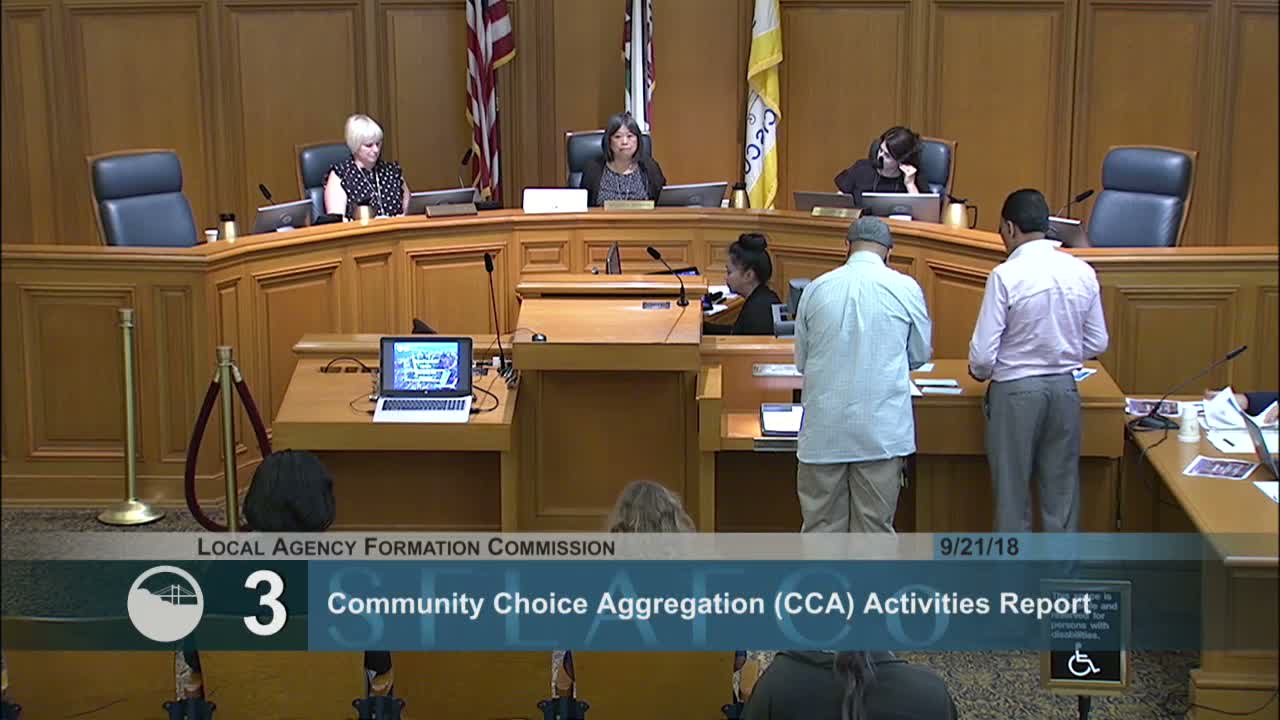
Barbara Hale, assistant general manager for power at the San Francisco Public Utilities Commission, told the Local Agency Formation Commission on Sept. 21 that Clean Power SF is now serving about 108,000 accounts and that the program’s 100% renewable “super green” option has a low but growing participation rate.
Hale said the program’s opt-out rate since launch is roughly 3.1 percent and that the super-green upgrade currently represents about 3.4 percent of active accounts; an October mini-enrollment of roughly 1,600 accounts is expected to increase super-green participation to about 3.6 percent. “We’re now actively serving about 108,000 accounts,” Hale said.
The PUC mailed required 2017 power-content labels to customers this month that describe the resource mix for each product. Hale said the green product’s delivered mix was 43 percent California RPS-eligible resources and 57 percent hydroelectric; the super-green product is shown as 100 percent RPS-eligible renewable energy and Green‑e certified. Customers on the green product receive a label comparing local product mixes with the statewide resource mix; Hale said all labels would be delivered by Oct. 1.
Hale pointed to the program’s climate impact, saying, “We estimate that Clean Power SF has reduced San Francisco’s electricity-related greenhouse-gas footprint by 82,000 metric tons,” and noted the city’s adopted goal to eliminate electricity-sector greenhouse gases by 02/1930.
On regulation, Hale summarized two competing California Public Utilities Commission proposals about exit fees that affect community-choice aggregators (CCAs). She described a judge’s proposal as “balanced” and neutral for CCA competitiveness; by contrast she said an alternate commissioner’s proposal would “shift costs to CCA customers” and could limit a CCA’s ability to offer service at prices comparable to PG&E. The PUC had signaled it intended to decide the matter at its Sept. 27 meeting in Sacramento.
Hale also reviewed state legislation the PUC and Clean Power SF followed this year, including references to bills discussed at the meeting as Assembly Bill 813 and Senate Bill 237 (direct access), Senate Bill 100 (accelerated RPS/100% clean energy policy), and wildfire-related proposals such as SB 901. She said the PUC and city officials had worked with trade groups and legislators to shape outcomes and to urge adoption of the judge’s CPUC proposal on exit fees.
Commissioners asked for demographic data on who is enrolling in green and super-green products and for evidence of targeted outreach to ethnic media; Hale said the PUC maintains multi-lingual materials, language-capable call center service and that staff would present enrollment-demographic statistics at a future meeting. She said recent outreach tied to the Global Climate Action Summit included citywide activations and media placements and that the PUC would follow with targeted campaigns to boost sign-ups.
No formal action was taken by LAFCO on the Clean Power SF presentation during the Sept. 21 meeting; staff committed to return with more outreach and demographic detail for commissioners to review.