Get Full Government Meeting Transcripts, Videos, & Alerts Forever!
Get email alerts on the Clean Power Sf topic
No spam. Unsubscribe anytime.
Clean Power SF updates growth plan and regulators; LAFCO moves to oppose SB 618
Summary
San Francisco PUC staff told LAFCO the Clean Power SF program serves about 75,000 accounts with low opt-outs and growing 100% 'Super Green' sign-ups, outlined financing and operational constraints for citywide expansion, and urged the commission to oppose SB 618, which would shift review of CCA integrated resource plans to the California PUC.
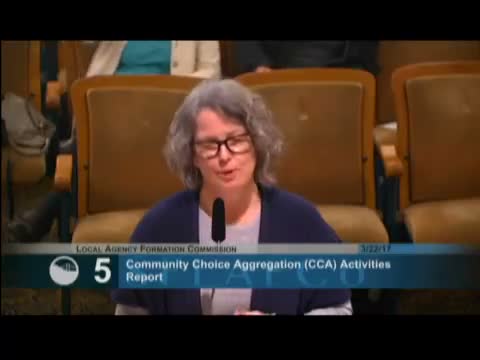
Barbara Hale, Assistant General Manager for Power at the San Francisco Public Utilities Commission, told the Local Agency Formation Commission on March 22 that Clean Power SF is operating in enrollment phases and is preparing a growth plan to guide expansion to full citywide service.
Hale said the program serves roughly 75,000 accounts, has a low opt-out rate of about 3.1 percent and that about 3.4 percent of participants have chosen the 100 percent renewable “Super Green” option. "We're offering a default green service with about 40 percent California-compliant renewable content," she said, and noted the PUC also offers a higher-cost 100 percent renewable product for customers who choose it.
Hale warned that a state charge known as the Power Charge Indifference Adjustment (PCIA) has created short-term volatility in customer bills. She described the PCIA as a California PUC implementation to allocate legacy utility costs when customers move to a CCA, and said that timing mismatches between CPUC decisions and local rate adjustments can temporarily raise Clean Power SF bills. "That process . . . doesn't really allow us much opportunity to buffer," she said, urging LAFCO to factor that instability into expansion timing.
On financing and operational readiness, staff said the PUC maintains a $40 million letter of credit and is exploring additional collateral and staffing needs required to scale from current enrollments to the roughly 320,000 accounts in the city. "Key questions are supply in the market, financing capacity and operational staffing," Hale said, noting a growth-plan presentation is targeted for late April or early May.
Hale also identified pending legislation that the PUC views as harmful to local decision-making. She described Senate Bill 618 as a measure that would require community choice aggregators to prepare integrated resource plans subject to review and approval by the California Public Utilities Commission instead of local governing bodies. "We are officially opposed to that piece of legislation," she said, and noted Mayor Lee has transmitted opposition to Sacramento.
Jason Fried, LAFCO’s executive officer, said LAFCO had not yet taken a formal position but recommended the commission align with the SFPUC and CalCCA in opposition if appropriate and to authorize staff to act between meetings on fast-moving items. "If we do take an opposed position, I will then participate with . . . CalCCA and the SFPUC to determine where are the right times," Fried said.
After public comment urging an aggressive local build-out and stronger Super Green promotion, commissioners moved to oppose SB 618 and authorized the executive officer to work with Chair Ronan on any adjustments to that position as the bill proceeds through committees.
What happens next: SFPUC staff will present a formal growth plan to their commission and plan to return to LAFCO to report on details and a recommended pace of rollouts; LAFCO authorized staff to represent the commission in legislative/regulatory discussions on SB 618.