Get Full Government Meeting Transcripts, Videos, & Alerts Forever!
Get email alerts on the Clean Power Sf topic
No spam. Unsubscribe anytime.
SFPUC briefs LAFCO on Clean Power SF expansion plans, procurement and schedule
Summary
San Francisco Public Utilities Commission staff told the Local Agency Formation Commission that Clean Power SF has roughly 80,000 customers, strong retention and a growth plan that aims to raise the program—s "green" product to 50% renewable by 2020 and complete citywide enrollment by February 2019; staff flagged procurement, PCIA and solar-tariff risks and described an approval timetable so contracts can be conditionally executed ahead of required public noticing.
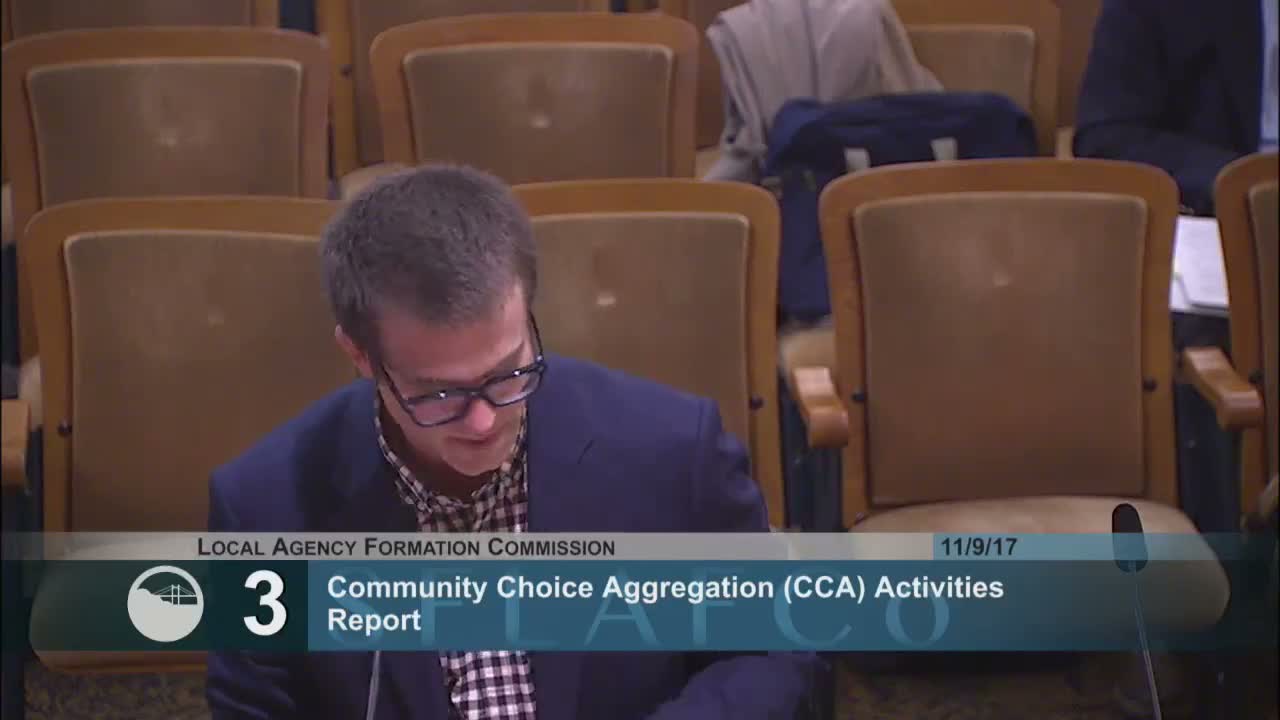
Michael Himes, director of the Clean Power SF program at the San Francisco Public Utilities Commission, told the Local Agency Formation Commission on Nov. 9 that the city—s community choice aggregation program is preparing to expand citywide and has assembled a pool of supply offers sufficient to support a major enrollment in 2018 and completion by February 2019.
"We have about 80,000 (customers) today," Himes said. "We've had a 96.8% retention rate or a 3.2% opt-out rate." He said the PUC—s plan is to increase the renewable content of the program—s default "Green" product to 50% by 2020 and to enroll 100% of eligible customers in San Francisco by February 2019 or sooner.
Why it matters: Clean Power SF would become one of the city—s largest utilities by accounts and revenue at full scale, shifting hundreds of millions in annual power procurement and creating local contracting and project-development work. The PUC—s growth decisions will affect local clean-energy investment, job-years tied to construction and longer-term rate stability for San Francisco customers.
Himes summarized two market solicitations issued this year. A renewable-energy request for offers drew proposals from 32 companies representing more than 70 distinct projects and roughly 300 unique bids; more than 90% of those offers were for new projects. A separate shaped-energy solicitation produced a smaller shortlist of five suppliers, intended to fill near-term gaps.
"More than 90% of the projects and the capacity are new, to be developed renewable energy plants," Himes said, stressing that many of those projects will require time to develop and that the program must balance short- and long-term contracts to limit risk.
Himes noted legal and market headwinds. Under state law, Clean Power SF must purchase some renewable energy under contracts of at least 10 years to support new resource development; the PUC also faces upward pressure on the PCIA (Power Charge Indifference Adjustment), which Himes called "a persistent uncertainty and risk for the program." He flagged a recent International Trade Commission ruling involving Suniva that could prompt tariffs on imported solar panels and drive up project costs.
On contracting and timing, Himes said the PUC plans to seek authorization for conditional execution of supply contracts in late January–February, then proceed with public notices that legally must begin in May if the program is to enroll customers in July. "We need to get a significant amount" of contracted supply to ensure rate stability and deliver the clean content the city expects, he said.
Commissioners sought specifics about the portfolio mix, contract terms and local benefit scoring. Himes said the procurement evaluation included a preference for projects in the nine-county Bay Area and that the PUC is prioritizing bids that can deliver energy in the near term to support an initial major expansion while also securing longer-term contracts to finance new projects.
Public commenters urged a faster schedule and broader local planning. Eric Brooks of the San Francisco Green Party asked LAFCO to press for an earlier full rollout in 2018; Jed Holtzman of 350 Bay Area said accelerating the procurement and enrollment process would reduce the chance of adverse market or regulatory outcomes that could hamstring the program.
What—s next: Himes said the PUC will introduce related legislation to the Board of Supervisors and seek a PUC action to authorize the general manager to negotiate and conditionally execute supply contracts, subject to tests and conditions the commission will set. The PUC will return to LAFCO and the board with updates as contracts and approvals advance.
No formal action was required of LAFCO at this meeting.