Get Full Government Meeting Transcripts, Videos, & Alerts Forever!
Get email alerts on the Clean Power Sf topic
No spam. Unsubscribe anytime.
Clean Power SF reports enrollment gains, issues renewable supply and financing RFPs
Summary
Staff told LAFCO the Clean Power SF program serves roughly 81,000 sites, has a low opt-out rate, and has issued requests for proposals for renewable supply and financing while the CPUC opened a rulemaking on legacy cost allocation.
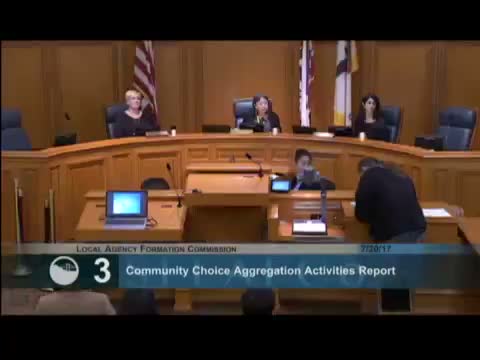
Barbara Hale, assistant general manager for power, told the Local Agency Formation Commission on July 20 that Clean Power SF is serving “about 81,000 sites right now” and that the program’s opt-out rate remains low. Hale said roughly 3.6 percent of customers had “opted up” to Super Green, the program’s 100 percent renewable product, and that opt-ups now exceed opt-outs.
Hale outlined procurement steps under way: LAFCO issued a renewable energy request for offers on June 22 seeking bids sized between 25,000 and 500,000 megawatt-hours per year, with initial deliveries possible as early as May 2018 and as late as December 2021. She said bids were due by 5 p.m. on July 26 and that staff held a pre-bid conference and webinars for prospective suppliers. “We’re engaged with the bidding community appropriately,” Hale said.
Staff also issued a companion financial RFP to secure collateral and financing support for contracts, Hale said, and reported that the commission had extended and increased the capacity on a marketing and outreach contract to support further enrollment. Executive Officer Jason Fried added that the MOU with the California Public Utilities Commission is moving through the budget committee and encouraged residents to sign up for Super Green before the July 24 deadline.
On the regulatory front, Hale pointed to a California Public Utilities Commission rulemaking opened on July 10 to review the power charge indifference adjustment (PCIA) and alternatives to the investor-owned utilities’ proposed portfolio allocation method (PAM). Hale described the new rulemaking as an opportunity to “look wholesale” at how legacy procurement costs are allocated and said Clean Power SF will respond in the proceeding on behalf of the city’s program.
There was no formal vote on the update. Public commenter Eric Brooks of San Francisco Clean Energy Advocates urged LAFCO to develop a local and regional build-out plan for renewable generation to support the program and estimated such a program could create local jobs.