Get Full Government Meeting Transcripts, Videos, & Alerts Forever!
Get email alerts on the Clean Power Sf topic
No spam. Unsubscribe anytime.
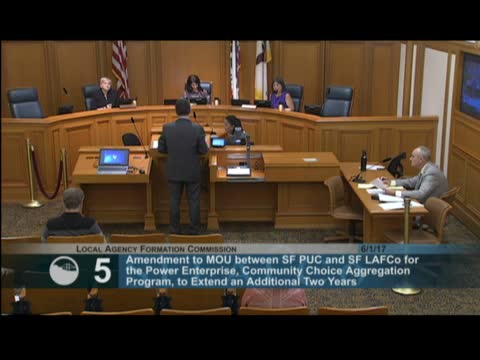
LAFCO approves two‑year MOU extension with SFPUC and hears Clean Power SF growth plan
Summary
LAFCO approved a two‑year extension of the MOU with the San Francisco Public Utilities Commission to continue Community Choice Aggregation (Clean Power SF) work and received the SFPUC's growth plan presentation proposing citywide enrollment by FY2018–19 and a 50% renewable default product target by 2020.
The Local Agency Formation Commission approved a two‑year extension of the memorandum of understanding with the San Francisco Public Utilities Commission that governs LAFCO's role in the Clean Power SF Community Choice Aggregation (CCA) program, and heard a detailed SFPUC presentation on a proposed growth plan.
SFPUC assistant general manager Barbara Hale and Clean Power SF Director Michael Himes presented the PUC's plan to expand enrollment from roughly 76,000 accounts to about 350,000 and to scale annual revenues from approximately $38 million to about $260 million. The plan sets a goal of enrolling 100% of eligible San Francisco customers by July 2019 (or sooner if possible) and recommends increasing the renewable content of the default "green" product to 50% by 2020.
Himes described a package of near‑term actions: issuing an RFP for financing support (expected by July 15), issuing requests for offers for power supply (expected by July 1), and staffing up with initial temporary hires (roughly 15 urgent positions) and a projected 50–55 full‑time equivalent staff at scale. He also described reliance on a third‑party back‑office provider (Calpine Energy Solutions) for billing and call‑center capacity during initial enrollments, with an option to unbundle services over time.
Commissioners and the public pressed the SFPUC on the timing for moving back‑office functions in‑house, the interaction between procurement results and the budget cycle, and protections for low‑income customers (approximately 13% of city accounts on the state's CARE program). Several public speakers and advocates urged LAFCO to stay involved in RFP processes and to watch California Public Utilities Commission proceedings and state legislation affecting CCAs (SB618, SB100, AB79/AB920 were discussed).
The extension of the MOU was approved without objection. SFPUC staff said the PUC has already approved the extension and that the Board of Supervisors will consider it as required by city rules because the extension moves the contract past a 10‑year threshold.
What happens next: The SFPUC will issue procurement solicitations according to the timeline presented; LAFCO asked staff to monitor CPUC proceedings and to coordinate with the chair on possible letters or positions on state legislation affecting CCAs.