Clean Power SF reports low opt-out rate, SFPUC authorizes expansion to 75 megawatts
Loading...
Summary
Clean Power SF officials told the Local Agency Formation Commission that the program has about 7,400 active service locations, an opt-out rate of 1.6% for the May enrollment and 3% participation in the 100% renewable 'Super Green' option. The SFPUC authorized increasing the program's initial size to 75 MW and directed staff to pursue short-term and longer-term renewable procurement.
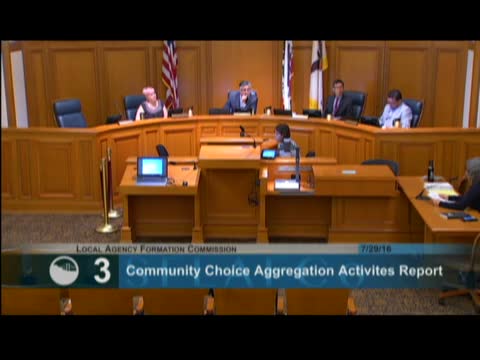
Barbara Hale, assistant general manager for power, reported to the Local Agency Formation Commission on July 29, 2016, that Clean Power SF has completed its initial operational phase and is preparing for the next enrollment.
"We continue to serve customers that were enrolled during the month of May," Hale said, reporting about 7,400 active service locations, roughly 7,000 commercial and 400 residential. Hale said the opt-out rate for the May enrollment is about 1.6%, well below the 20% projected during planning, and that Super Green — the 100 percent renewable product — currently accounts for roughly 3% of enrollments.
Hale described outreach steps for the August enrollment period, including a bill-calculator tool and a "how to read your bill" tutorial posted on the Clean Power SF website to help customers compare rates with PG&E. She said staff were finalizing notices and an advertising campaign aimed at Districts 5 and 8, where survey data showed stronger interest in the Super Green product.
Hale said the San Francisco Public Utilities Commission on Tuesday authorized the general manager to exceed the initial 50-megawatt program size originally envisioned and set a new initial limit at 75 megawatts. "The action also set a new limit on the initial size of the program at 75 megawatts," she said, adding that the SFPUC authorized negotiating and executing additional contracts to serve up to that average demand.
On procurement, Hale said the program will use standard industry short-term contracts (Western Systems Power Pool) to meet near-term needs while initiating a competitive procurement for longer-term renewable supplies.
Hale also flagged regulatory and market risks at the California Public Utilities Commission that could affect program economics, including the power charge indifference adjustment (PCIA). She noted recent public discussion and PG&E announcements about the potential closure of the Diablo Canyon nuclear plant and the utilities' conversations about how replacement costs might be allocated. "We definitely have a strong interest in that," Hale said of engagement at the CPUC.
Jason Fried, LAFCO executive officer, told commissioners he would monitor CPUC activity during the August recess and could coordinate letters of support or other staff actions if urgent filings or proceedings arise.
The Clean Power SF update was provided for information; the chair opened public comment and none was offered.