Get Full Government Meeting Transcripts, Videos, & Alerts Forever!
Get email alerts on the Clean Power Sf topic
No spam. Unsubscribe anytime.
Clean Power SF reports 76,800 customers as commissioners press CPUC on PCIA volatility
Summary
SFPUC staff told LAFCO that Clean Power SF now serves about 76,800 customers, with a roughly 2% opt‑out rate and more than 1,500 'super green' customers; commissioners pressed for stability in the PCIA rate mechanism and discussed legislative and regulatory paths to reduce year‑to‑year volatility.
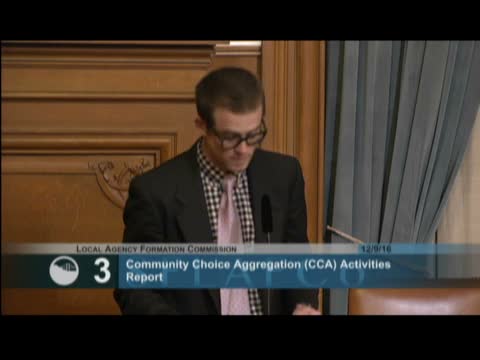
Michael Himes, director of the Clean Power SF program for the San Francisco Public Utilities Commission, told the San Francisco LAFCO on a program update that Clean Power SF enrolled about 72,000 new service points in November and is now serving roughly 76,800 active customers. Himes said the program’s opt‑out rate stands at about 2 percent and that more than 1,500 customers — a bit more than 2 percent of the active base — have opted for the program’s higher‑tier "super green" product.
The program’s outreach has included advertising at the Castro Muni station and Muni bus shelters, Himes said, and the SFPUC hosted welcome events at the African American Arts and Culture Center and planned a Sunday event at the Eureka Valley Recreation Center. Himes said staff are targeting a 5 percent participation rate for the super green product and reported 255 sign‑ups for the next enrollment window, about 77 percent of which chose super green.
Himes said staff have launched phase 1 of the program and are developing a growth plan to scale Clean Power SF citywide, focusing on electricity market supply conditions, customer demand, financing for increased power purchases and operational readiness. He estimated current enrollment represents about 10 to 15 percent of the program’s potential size and described an approximately eightfold increase in enrollment needed to reach citywide scale.
On regulation, Himes warned commissioners that pending action at the California Public Utilities Commission (CPUC) on the Power Charge Indifference Adjustment (PCIA) could mean a "small bill increase" for Clean Power SF customers relative to PG&E service until the next PG&E rate change. He said the CPUC was expected to issue a decision on the issue around Dec. 15 and that related rate adjustments could take effect Jan. 1. Himes described a CPUC working group on PCIA reform that is charged with producing a report by mid‑2017 and said staff were also considering legislative options to reduce year‑to‑year volatility in the PCIA.
Chair John Avalos and other commissioners asked whether the CPUC’s processes favor investor‑owned utilities over community choice aggregators. Himes responded that the CPUC represents ratepayers — including CCA customers — but acknowledged statutory constraints on the commission’s authority and said some fundamental changes to the PCIA mechanism likely would require legislative action. He recommended seeking more predictable forecasting approaches to reduce disruptive annual volatility for business planning.
Jason Fried, LAFCO executive officer, said he was encouraged by the staff work on a growth plan and expressed concern that CPUC practice had, at times, advantaged bundled utility customers over CCA customers. Public commenters including Jed Holtzman of 350 Bay Area urged the commission and city officials to "work aggressively to defend and build and protect Clean Power SF" and warned that higher bills than PG&E would harm the program’s adoption.
Next steps cited by staff included continuing outreach and sign‑up activity, refining the program growth plan for citywide scaling, participating in the CPUC working group on PCIA reform and exploring legislative strategies should regulatory change be insufficient. The commission took no formal action on the update beyond discussion and public comment.