Get Full Government Meeting Transcripts, Videos, & Alerts Forever!
Get email alerts on the Clean Power Sf topic
No spam. Unsubscribe anytime.
Clean Power SF reports rising enrollments, low opt‑out rates and new outreach push
Summary
San Francisco’s Clean Power SF reported expanded enrollment notices for a fall tranche, low opt‑out rates for earlier cohorts, continuing procurement work to meet state resource adequacy and long‑term contracting rules, and a targeted advertising campaign in Districts 5 and 8.
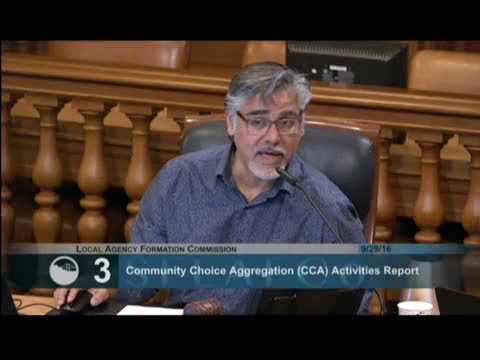
San Francisco’s Clean Power SF program told the Local Agency Formation Commission on Sept. 29 that it has ramped up outreach and enrollment while continuing to work through state procurement requirements.
"We're serving 7,300 active locations right now," Barbara Hale, assistant general manager for power, said in presenting the update. She said the program’s May cohort stabilized at about a 1.9 percent opt‑out rate and that staff has sent 67,400 enrollment notices for the next tranche. Hale said about 151 customers have upgraded to the Super Green 100 percent renewable option and that, to date, only about 0.4 percent of notice recipients have opted out.
The report flagged two regulatory procurement obligations under California law. Hale said Clean Power SF must meet resource adequacy requirements intended to ensure enough capacity on the grid and must demonstrate long‑term renewable contracts that meet the state’s long‑term contracting requirement. "We actually finalized one of four" resource adequacy arrangements and are still working on the remaining contracts, she said. On the long‑term contracting requirement, Hale said staff is "making progress" but had no final results to report.
Hale also described formalized coordination with other community choice aggregators (CCAs). She said those partnerships are now organized in the California Community Choice Association (Cal CCA), which will convene local agencies in October to share planning and operating experience. Jason Fried, LAFCO’s executive officer, noted that state legislation AB 1110 had been passed and signed and that the Legislature deferred technical greenhouse‑gas formula work to the California Energy Commission.
On staffing and program planning, Hale said Clean Power SF now has eight operations staff and three communications staff plus one consultant (a dedicated team of 12). Staff are drafting a growth/phasing plan, an integrated resource plan required by state law, and program materials for rate changes, feed‑in tariff integration and possible community/shared solar programs.
The outreach push includes small billboards in Districts 5 and 8, a dominant ad placement at the Castro Street Muni station, and bus shelter ads. Hale showed five creative examples aimed at encouraging customers to upgrade to the Super Green option.
The commission did not take a formal vote on Clean Power SF policy at the meeting. Commissioners asked staff to provide a memo summarizing the program plans, and staff said it would return with more detailed materials and engage with stakeholders as the program moves toward broader enrollment and operational readiness in coming months.