Get Full Government Meeting Transcripts, Videos, & Alerts Forever!
Get email alerts on the Clean Power Sf Pcia Netmetering topic
No spam. Unsubscribe anytime.
San Francisco LAFCO and supervisors urge CPUC to reject PG&E proposals on net metering and PCIA, warn of financial hit to Clean Power SF
Summary
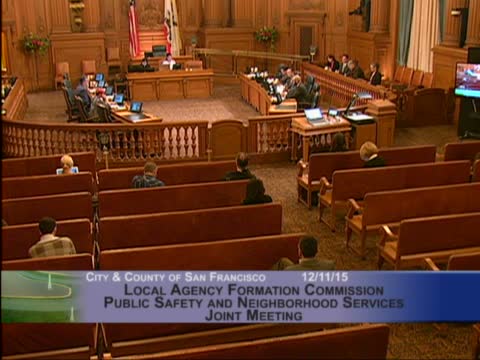
At a joint Dec. 11 meeting, LAFCO and the Public Safety committee heard presentations from Vote Solar and Lean Energy and approved technical amendments before instructing staff to send letters to the California Public Utilities Commission opposing PG&E proposals to cut net‑metering credits and to a proposed PCIA increase; presenters warned the changes could shave millions from Clean Power SF’s early revenues and force contingency measures.
LAFCO and the Public Safety & Neighborhood Services Committee met jointly on Dec. 11 to consider two related resolutions urging the California Public Utilities Commission (CPUC) to reject utility proposals that advocates say would undermine rooftop solar and community choice aggregation programs.
The Board of Supervisors’ resolutions (file nos. 151230 and 151231) call on the CPUC to reconsider proposed cuts to net energy metering credits and to assess the fairness and transparency of the Power Charge Indifference Adjustment (PCIA), an exit or departing‑load fee that affects community choice aggregators (CCAs) such as Clean Power SF.
Susanna Churchill, West Coast regional director for Vote Solar, told commissioners that the CPUC had not issued a final decision and that utility proposals—most prominently from Pacific Gas & Electric—seek to reduce bill credits for exported solar by more than 50% and add new fees (including a proposed $3 per‑kilowatt monthly demand charge). "If PG&E's proposal was adopted by the CPUC, it would drastically reduce solar savings for solar customers and thereby drastically slow down continued solar growth," Churchill said.
Shawn Marshall of Lean Energy described the PCIA as a departing‑load charge that was "scheduled to go up...over 100%" for 2016, estimating roughly 2.3 cents per kilowatt‑hour and projecting a potential partial‑year impact to Clean Power SF of about $8.4 million in 2016. Marshall urged the CPUC to increase transparency in the PCIA calculation, commission a third‑party audit of assumptions and contracts that feed the formula, and consider smoothing mechanisms so CCAs do not face sudden rate shocks.
Barbara Hale, Assistant General Manager for Power at the San Francisco Public Utilities Commission (SFPUC), said SFPUC staff had rerun Clean Power SF financial models in light of the proposed PCIA and found the program's estimated net operating margin could fall from about 8% to roughly 6.5% under the higher PCIA scenario; staff said the SFPUC adopted a similar resolution urging the CPUC to moderate impacts and requested a reexamination of the PCIA calculation method.
Public commenters—leaders and advocates from local clean‑energy organizations—urged the commissions to act aggressively at the CPUC, warning that the PCIA and net‑metering changes could undermine CCAs' ability to offer competitive rates and to fund local renewable build‑out. Several speakers requested direct engagement with CPUC commissioners and urged the Board and LAFCO to be prepared to take fast action if the CPUC moves to approve the proposed changes.
Committee action: the committee accepted several technical amendments to the two resolutions and agreed to forward a committee report to the full Board of Supervisors. LAFCO commissioners and Board members also adopted a motion instructing staff to draft and transmit letters to the CPUC and to coordinate local government advocacy; that motion was carried "without objection." No CPUC ruling was made at this meeting; presenters emphasized the CPUC process still afforded opportunities for public comment before a final decision, with a proposed decision expected before a final order in mid‑January.
Next steps: staff will draft the letters directed to the CPUC and coordinate with the chair and local partners on advocacy; the Board will consider the committee report at the upcoming Board meeting and may transmit the resolutions and letters to state officials.