Get Full Government Meeting Transcripts, Videos, & Alerts Forever!
Get email alerts on the Clean Power Sf topic
No spam. Unsubscribe anytime.
San Francisco officials project short delay to Clean Power SF launch as large supplier bids prompt business-plan review
Summary
PUC and LAFCO staff said a larger-than-expected set of supplier bids and contract-size limits will likely push Clean Power SFlaunch back about six weeks while staff completes a business plan and seeks Board of Supervisors approval for some contracts.
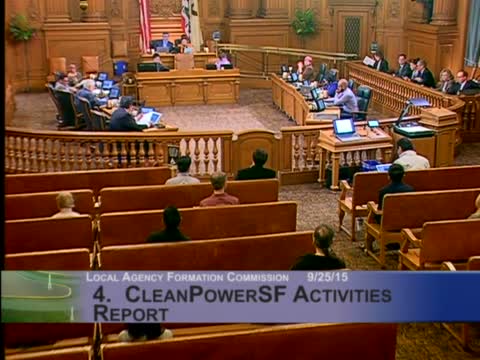
San Francisco officials told a joint Public Utilities Commission (PUC) and LAFCO meeting that the planned spring launch of Clean Power SF is likely to slip by about six weeks as staff completes a more rigorous business plan and processes contracts that exceed city procurement delegation limits.
"We have such a high volume" of bids that the evaluation, due diligence and contract exceptions have lengthened the timeline, Barbara Hale, assistant general manager for power at the San Francisco PUC, said during the Sept. 1 joint meeting. "We received 52 bids" for one category of renewable supply, Hale said, adding that other bid categories included six bids each for firmed-and-shaped products and for resource adequacy.
Why it matters: staff said competitive pricing is available but some of the most attractive offers exceed the PUC's delegated contracting authority and the city's charter threshold, which would require Board of Supervisors approval. That extra step — together with a decision to present a public-facing business plan and a third-party review of risk — is the principal cause of the estimated delay.
Harlan Kelly, general manager of the PUC, described the set of proposals as "a really good problem to have" and said he supported "moving as quickly as possible" while completing necessary reviews. Jason Fried, executive officer for LAFCO, urged the boards to "dual track" the business-plan work and contract approvals so that contract negotiation and board submission can proceed concurrently with the business-plan review.
Procurement details: staff said the procurement solicited three product types. Bid option 1 (firmed and shaped energy) produced six bids offering approximately 300 gigawatt-hours in the early program years and ramping to about 440 GWh over a three-year contract. Bid option 2 (firmed and shaped renewable energy) returned 52 bids, many from California projects; resource-adequacy offers numbered six. By way of scale, Hale said a typical San Francisco year is about 6,000 GWh.
Contract thresholds and approvals: Hale and other staff said some attractive combined conventional-and-renewable offers push annual payments above the PUC's $5,000,000 delegated cap and past the $10,000,000 charter threshold that requires Board of Supervisors action. "We now anticipate that we will be coming back to the board of supervisors for approval of some of these contracts," Hale said.
Staff proposal to limit delay: PUC staff proposed seeking conditional authority from the PUC to send shortlisted contracts to the Board of Supervisors with conditions, such as requiring verification of affordability and confirmation of financial viability before any contract signature. That approach, staff said, would allow negotiation and conditional submission to proceed in parallel with finishing the business plan and the third-party risk review.
Timeline specifics: staff previously intended to bring a risk assessment and contract authorization to the PUC on Oct. 13. Under the revised plan, staff said they may present contracts with conditional authorization and an outline of the business plan on that date, then complete the full business plan and third-party review in November–December. Staff noted a regulatory sequence that would require sharing an initial list of automatically enrolled customers with Pacific Gas and Electric Company (PG&E) by Jan. 26; PG&E would have a 30-day period to review, which would make Feb. 26 the earliest possible service date under the existing regulatory timing. Hale said the schedule shift under consideration would move a March start into the spring window and could push initial service toward May if Board timing requires more steps.
Outreach and enrollment: PUC outreach staff said about 220 people had enrolled in the program's early sign-up site at CleanPowerSF.org and described a citywide strategy of early voluntary sign-ups followed by phased automatic enrollment. Staff said Phase 1 would focus on the southeast sector of San Francisco (excluding the Hunters Point Shipyard, which is served by the city's power enterprise), chosen for its roughly 60/40 commercial-residential load mix to help stabilize early revenue. Staff said they aim to enroll a modest share of customers into a 100% "super green" premium product (target ~5% of phase-1/2 accounts) and to keep opt-out rates for the default green product under 20%.
Public reaction: community speakers and several supervisors urged staff to avoid delays, warning that PG&E's competing green tariff could capture customers if Clean Power SF is not first to market. "If PG&E manages to launch their 100% green program, they are the first mover," said Jed Holtzman of 350 San Francisco during public comment. Several environmental and neighborhood advocates asked for conditional approvals that would allow the initial 30-MW startup contracts to proceed while longer-term business planning continued.
Actions and next steps: the joint bodies took no final procurement action at the meeting. Staff committed to deliver a revised schedule that will identify which contracts can be signed without Board action and which will require supervisors' approval; staff also confirmed they will continue evaluating bids, completing due diligence, and working with the city attorney and a third-party financial adviser on the business plan and risk review. The PUC and LAFCO indicated they still aim for a spring launch window but acknowledged the timetable could move by several weeks depending on Board scheduling and final due diligence.
What remains unresolved: whether the Board of Supervisors will grant any expedited or conditional approvals that would permit signature within the earlier timeline, and which specific contracts will require formal supervisor authorization. Commissioners and staff also asked for a public timeline with more precise dates for each milestone.