Get Full Government Meeting Transcripts, Videos, & Alerts Forever!
Get email alerts on the Clean Power Sf topic
No spam. Unsubscribe anytime.
SFPUC staff outlines Clean Power SF business plan, contracting strategy and outreach ahead of spring 2016 launch
Summary
SFPUC officials told LAFCO staff and advocates on Oct. 23 that Clean Power SF plans a phased launch in spring 2016, has modeled enrollment and revenue scenarios, and is using a two-step contracting approach to limit supply-cost risk while ramping outreach and enrollment in the Southeast.
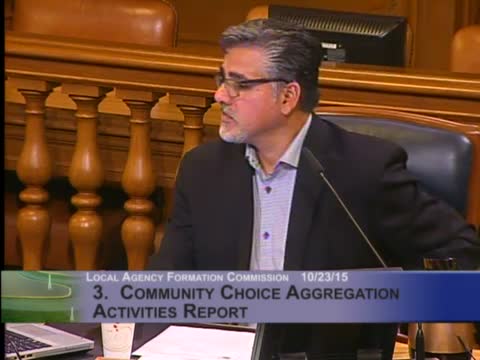
San Francisco Public Utilities Commission officials presented a detailed update on Clean Power SF — the city’s Community Choice Aggregation program — at the Local Agency Formation Commission meeting on Oct. 23, 2015. Barbara Hale, assistant general manager for power, said staff are testing financial viability under different enrollment and opt‑out scenarios and are pursuing contracting steps to reduce exposure to volatile wholesale prices.
Hale told commissioners the program’s initial enrollment case is modeled at 30–50 megawatts (roughly 20,000–75,000 accounts), which staff estimate would correspond to about $35 million in annual expenditures. Full enrollment would be substantially larger — about 400 megawatts and roughly 300,000 accounts, producing an estimated $270 million in annual operating revenue. Hale said staff are modeling renewable-content choices (about 33–50 percent for the basic green product) and testing whether the program remains both affordable and financially stable under higher opt‑out rates.
The presentation emphasized enterprise‑wide risk management. Hale said the highest single program cost is procuring supply — about 70 percent of program cost — and that without mitigation supply‑cost risk scored highly. To reduce that exposure, staff plan a two‑step procurement: conditional commission approval of a supplier pool and a master agreement in mid‑December, followed by a confirm phase in early January to set specific prices and volumes. Hale said staff expect to sign master agreements with multiple counterparties and then execute confirms with a subset that yields best pricing.
On schedule, Hale reported a modest slip: staff now expect a phase‑1 launch in March 2016 and to begin serving customers in mid‑April 2016, with statutory notices and rate steps occurring from December through March. She said the commission will seek conditional approvals in late October and mid‑December before bringing contract approvals to the Board of Supervisors for final authorization.
Outreach and enrollment logistics were covered by Charles Sheehan, communications manager for Clean Power SF. Sheehan described a campaign including bilingual brochures (English, Chinese and Spanish), flyers, volunteer toolkits, neighborhood events, door‑to‑door canvassing in targeted neighborhoods, paid outdoor advertising and social‑media activity. He said staff will begin sending a pre‑mailer on Jan. 4 to customers slated for automatic enrollment, with opt‑out notices slated to go to the post office on Jan. 15 and Feb. 15, and additional paid advertising beginning in mid‑March to coincide with the opt‑out period.
Commissioners and staff discussed a recurring operational hurdle: many people at outreach events do not have their PG&E account number handy, which complicates on‑the‑spot enrollments. Staff said they are working on alternative sign‑up flows (for example, address‑based lookup or back‑office verification) with their back‑office contractor, identified in the presentation as Noble Americas, and will coordinate city legal review where needed. Hale also told the commission that the Board of Supervisors has appropriated $4 million in working capital to support launch; she cautioned that confirm prices could make the program unaffordable but said she does not expect that outcome based on current forward pricing indicators.
Public advocates at the meeting voiced strong support for a timely rollout but urged better collaboration and clearer branding. Eric Brooks of the San Francisco Green Party and allied advocates urged staff not to delay the first 30–50 megawatts of rollout. Jess Durbin Ackerman of the Sierra Club’s Bay Chapter recommended a distinct Clean Power SF social media presence rather than communicating solely through SF Water channels. Other advocates from 350SF and related groups urged aggressive community partnership and assistance with enrollment in the Southeast.
Next steps, as described by staff, include conditional commission action on supplier approvals and the master agreement in December, confirm negotiations in January, statutory notification and opt‑out mailings beginning mid‑January, and customer service processes to begin as customers are rolled into the program in mid‑April. Commissioners said they will continue to coordinate district work plans and outreach toolkits with SFPUC staff and supervisor offices.
The presentation was informational; no formal board vote was recorded on program adoption during the Oct. 23 meeting. The commission opened the item to public comment and heard multiple advocates before moving on to later agenda items.