Get Full Government Meeting Transcripts, Videos, & Alerts Forever!
Get email alerts on the Undergrounding topic
No spam. Unsubscribe anytime.
LAFCO study finds limited new funding options for undergrounding wires; recommends "dig once" coordination
Summary
A draft LAFCO study on undergrounding utilities and expanding fiber found no previously unidentified funding sources, estimated per-mile costs from roughly $2 million to $5 million, and recommended coordinated "dig once" planning and leveraging street resurfacing; staff will finalize a report for the June 19 meeting.
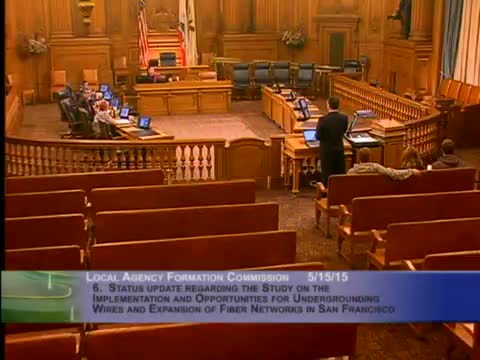
LAFCO staff told the commission May 15 that a draft study on undergrounding overhead utility wires and expanding fiber in San Francisco found no new, immediately available funding sources and that costs vary widely by location and method.
Executive Officer Jason Fried said the draft, which was open for comment through the meeting date, examines past work (including a 1996 undergrounding program), the state Rule 20 funding mechanism and possible cost-reduction measures. Fried told commissioners the Rule 20 allocation is modest and that past estimates from PG&E had been lower than actual costs when the work was performed. He summarized a range of cost estimates presented in the study: "somewhere between, high 2,000,000 to about 5,000,000 range," per-mile estimates the draft cites depending on site conditions and scope of work.
The draft concluded that, at current funding levels and approaches, completing citywide undergrounding under Rule 20 would take centuries: Fried cited an illustrative figure that doing nothing new could take roughly 600 years to underground the city. The staff report identified several obstacles: limited Rule 20 funds, once-only work by PG&E in past programs that left the city repaying over decades, access and coordination challenges when private property owners decline needed hookups, and widely varying construction conditions (hills, landfill, rock) that drive costs.
The report recommends practical steps to reduce incremental costs and accelerate work where feasible. Those include improved coordination with street resurfacing schedules so undergrounding work can be done concurrently (a "dig once" approach), exploring opportunities to let the city perform undergrounding work under PG&E oversight, and developing a master plan to sequence projects and combine funding streams. Fried said some funding options (general obligation bonds, utility-user-tax increases, transfer taxes or a residential user surcharge) would require voter approval and likely face Proposition 26 constraints.
The draft also noted local examples where new construction or redevelopment is already being built underground (Treasure Island; parts of Bayview Hunters Point and other redevelopment sites), and recommended including planning recommendations to ensure new neighborhoods are wired underground from the outset. Fried said he aimed to present a final report at the commission's June 19 meeting and to add step-by-step implementation recommendations in the final draft.
The item was informational; commissioners asked staff to work closely with Supervisor Tang's office, incorporate comment, and return with a final draft and next-step options.