Get Full Government Meeting Transcripts, Videos, & Alerts Forever!
Get email alerts on the Community Choice Aggregation topic
No spam. Unsubscribe anytime.
SFPUC and Clean Power SF report regulatory progress as PG&E files green-tariff advice letters
Summary
SFPUC and Clean Power SF staff told the LAFCO commission that PG&E filed three CPUC advice letters on a green-tariff program and that SFPUC'recommended not-to-exceed rates were sent for a 30-day Board of Supervisors review; staff said procurement work and RFPs are on a summer timetable and a July-October contracting window is likely.
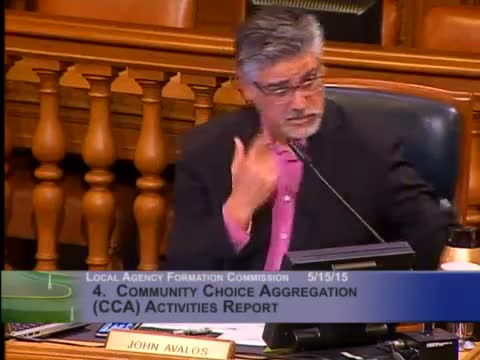
San Francisco Public Utilities Commission staff and Clean Power SF officials told the Local Agency Formation Commission on May 15 that the Community Choice Aggregation program is moving through regulatory and procurement steps, even as investor-owned utility PG&E seeks to finalize a parallel green-tariff offering.
Barbara Hale, assistant general manager for power at the SFPUC, said the SFPUC adopted staff recommendations on not-to-exceed rates on May 12 and had transmitted those recommendations to the Board of Supervisors for a statutorily required 30-day review ahead of the board's second reading on May 19. Hale also said the SFPUC secured a $4,000,000 appropriation for the CCA program that passed the commission on April 28 and has been introduced at the Board of Supervisors.
The regulatory picture includes three advice letters PG&E filed with the California Public Utilities Commission, Michael Himes, interim director of Clean Power SF, said. The letters describe proposed program terms and conditions, a marketing plan and a procurement approach for PG&E's green-tariff product. Himes summarized key consumer protections in those filings: customers enrolling in the green tariff may purchase either a 50 percent or 100 percent option and can cancel enrollment without a termination fee, though a customer who deenrolls would be unable to reenroll for one year. Himes also reported that most PG&E prices in the filings exceed the 2-cent premium Clean Power SF had proposed as a cap; "two classes of customers, small commercial and medium commercial, are slightly below the 2¢," he said.
Himes said the PG&E filings are subject to a protest period and CPUC review; "protests are due June 2," he said, and SFPUC staff were evaluating whether to file comments or protests. He added that PG&E's marketing plan reported a year-one marketing budget of $1,500,000 and that PG&E said it would provide materials mentioning CCAs or the green tariff to the CPUC's public advisor's office for review.
On procurement and operations, Hale and Himes described several near-term contracting steps: an operational communications contract is in place, the back-office/customer-care and billing/data-services RFP was expected to be released in the following weeks, and staff anticipated a notice-to-proceed for some contracts in the October timeframe. Pacific Energy Advisors is under contract to assist with procurement planning, Himes said. He characterized the supplier market as competitive and active: "suppliers are seeing a lot of bids," Himes said, adding that jurisdictions such as Marin Clean Energy and Sonoma Clean Power have produced multiple competitive responses.
Commissioners asked that staff return with a follow-up presentation showing the market for potential suppliers and the types of energy products available, including contract sizes in megawatts. Hale and Fried agreed to bring that information back within the requested timetable.
The SFPUC and Clean Power SF presentations were informational; commissioners opened and closed public comment without speakers. The next procedural steps staff identified include refining RFPs this summer, finalizing back-office contracts and allowing CPUC review of PG&E advice letters before Clean Power SF sets final retail prices in relation to any CPUC decisions.