Get Full Government Meeting Transcripts, Videos, & Alerts Forever!
Get email alerts on the Clean Power Sf topic
No spam. Unsubscribe anytime.
Department of the Environment outlines how CCA could expand San Francisco energy‑efficiency programs
Summary
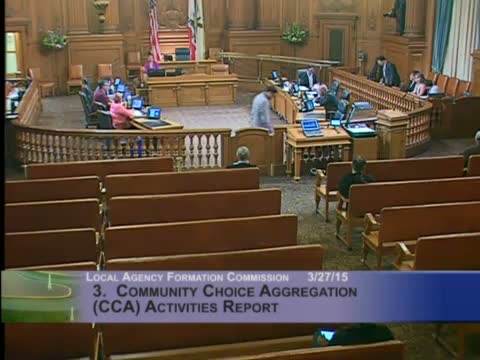
The City Department of the Environment told LAFCO on March 27 that San Francisco’s long-running efficiency programs (SF EnergyWatch and BayREN) could be expanded under Clean Power SF’s CCA, but regulatory limits at the CPUC and financing constraints will determine what can launch at rollout.
The San Francisco Department of the Environment on March 27 told the Local Agency Formation Commission (LAFCO) that the city’s 15-year portfolio of energy‑efficiency programs could be broadened under the Clean Power SF community choice aggregation (CCA) program, but that regulatory hurdles and financing tools will shape what is feasible at launch.
“San Francisco has set some very aggressive climate goals,” Department Director Debbie Raffel said. “One of our goals is a 100% renewable electricity. In order to meet that…we must maximize our ability to use electricity wisely, which means energy efficiency.”
Kathleen Bridal, a department program lead, described two core locally run offerings: SF EnergyWatch, a lighting-centered program in operation since February 2006, and a Bay Area Regional Energy Network (BayREN) multifamily program that began in 2013. Bridal said the department now contributes roughly 40% of San Francisco’s local energy‑efficiency portfolio and that the city has completed about 15,000 projects over 15 years, paying $40,000,000 in incentives that the department estimates reduced CO2 emissions by about 92,000 tons — “the equivalent of removing 15,000 vehicles from the road.”
The department framed CCA as a way to remove program design limits imposed by existing utility‑administered funding channels. Bridal explained that current ratepayer-funded programs administered by PG&E and overseen by the California Public Utilities Commission (CPUC) constrain what savings counts as "claimable" (for example, a 60‑watt incandescent replaced by a 10‑watt LED would intuitively save 50 watts, but only about eight watts may be considered claimable above the state Title 24 baseline). That accounting limit reduces incentives for deeper, costlier measures such as chillers and central‑plant upgrades.
Bridal said a CCA‑managed program could use actual project savings as a baseline to increase incentives, lower payback periods for deeper retrofits and make larger measures economically viable. She recommended a phased, whole‑building approach: start with commercial and common‑area lighting, move into restaurant and residential measures, and then address heating and hot‑water systems; eventual on‑site renewables and storage could follow once load is reduced.
Financing remains a constraint. Bridal noted PG&E’s on‑bill finance program has a $5,000 minimum loan and five‑year maximum payback, which she said discourages some contractors; the department is pursuing PACE mechanisms for mid‑ and large‑sized customers, while small customers remain a financing challenge.
SFPUC Assistant General Manager Barbara Hale told the commission the city will pursue CPUC authority to administer public‑good charge funds currently handled by utilities so the city could use those dollars for CCA efficiency programming. Hale said SFPUC planned to file to become an administrator during the year and that the CPUC’s timeline — including pending advice letters and workshops on PG&E’s green‑tariff filing — is the biggest uncertainty for expanded program rollout.
Hale summarized CPUC timing: workshops by IOUs on April 16, a PG&E workshop on customer implementation April 23, a PG&E advice‑letter filing expected May 9, and comments or protests due May 29. She also flagged the Power Cost Indifference Adjustment (PCIA), saying parties are seeking exemptions for low‑income customers from the PCIA charge that can follow customers when they leave PG&E for a CCA. Hale said the PCIA is roughly “about a penny per kilowatt hour” and that exemptions for CARE/low‑income customers are being litigated at the CPUC.
Commissioners asked when expanded CCA efficiency programming could begin. Bridal and SFPUC staff said existing local programs (EnergyWatch, BayREN) will continue at launch; additional CCA‑specific measures depend on whether the CPUC grants administrative authority and how much public‑goods funding is allocated to the city. Commissioners also asked about non‑combustion heating in new construction, state code updates such as the Residential Energy Conservation Ordinance (RICO), and learnings from Sonoma and Marin CCAs.
Public commenters — including Eric Brooks of the San Francisco Green Party and Jed Holtzman of 350 San Francisco — urged LAFCO to accelerate rate‑setting and legislative steps to prevent PG&E’s competing green tariff from undercutting local CCA build‑out. Advocates asked that LAFCO and SFPUC prioritize local, behind‑the‑meter resources and ensure program revenues are used to support local project financing and workforce development.
What’s next: SFPUC staff said they plan to submit an application this year to the CPUC to become an administrator of energy‑efficiency funds, and they will bring proposed "not‑to‑exceed" rates to the Rate Fairness Board (meeting tentatively April 17) and program design and proposed rates to the SFPUC commission on April 14. LAFCO asked staff to keep reporting enrollment figures and regulatory updates in regular reports.