Get Full Government Meeting Transcripts, Videos, & Alerts Forever!
Get email alerts on the Clean Power Sf topic
No spam. Unsubscribe anytime.
San Francisco accepts InterNex report, directs accelerated timeline for Clean Power SF
Summary
After hearing an InterNex feasibility study, the SFPUC and LAFCO accepted the report and directed staff to accelerate planning for Clean Power SF, while staff warned state opt-out notice rules and city contracting limits constrain launch timing.
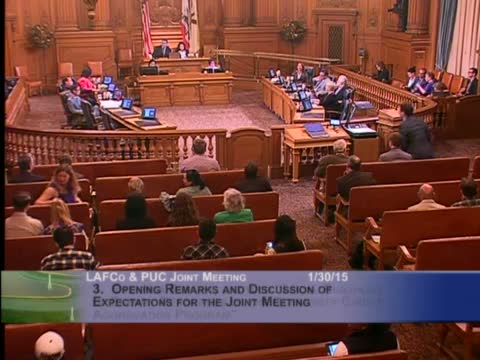
San Francisco officials accepted a technical feasibility report on Clean Power SF and pressed staff to return with an accelerated implementation timeline. At a Jan. 30 joint meeting of the San Francisco Public Utilities Commission and the San Francisco Local Agency Formation Commission (LAFCO), commissioners and supervisors voted to accept an InterNex study of community choice aggregation and to extend an MOU between the PUC and LAFCO to support implementation.
The InterNex report, presented by Jeremy Loundergan, director of utility services consulting for InterNex, concluded that the SFPUC’s Power Enterprise "does have the capability to do the power procurement on behalf of Clean Power San Francisco," but advised that near-term operations would likely require partners for real‑time balancing and that internal capabilities could develop over time. Loundergan recommended a phased program, including a two‑tier product offering: a default ‘‘light green’’ option set at or near current PG&E generation rates and a higher‑renewable ‘‘dark/evergreen’’ opt‑up product that would be pursued later.
"It should be possible for the SFPUC to fulfill that role that was initially envisioned to be supplied by Shell," Loundergan said, adding that detailed project sizes, updated cost estimates and refined rate analysis are required before procurement.
SFPUC Assistant General Manager Barbara Hale said the report reinforced many PUC design elements and repeated staff priorities: set rates within an affordability ceiling, staff up the program, and revise contracting authority so the PUC can operate at a commercial pace. "With Shell out of the picture, we're now talking about this new idea of changing some of the contracting approach that we have authority for," Hale said, and warned that some statutory steps — including opt‑out notice timelines required by state law — are fixed and limit how quickly a launch can proceed.
Commissioners and supervisors nonetheless urged speed. Commissioner (Vice President) Viator directed staff to "accelerate the timeline and come back to the PUC by February at the latest with an earlier date to complete the plan and to launch the program." Multiple supervisors and public commenters said the city should aim to set a not‑to‑exceed rate and begin implementation work this year rather than waiting until year end.
Public commenters representing environmental groups and neighborhood advocates widely praised the report and called for an early launch. Linda Weiner of the Sierra Club urged a launch no later than Sept. 30 and said rates should not exceed current utility rates. Woody Hastings of the Center for Climate Protection and other advocates offered technical assistance and cited Marin and Sonoma as regional precedents.
Formal actions at the meeting included a motion to accept the InterNex report, moved by Commissioner Campos and seconded by Commissioner Cruz; the motion passed without objection. The commissions also approved a no‑cost two‑year extension of the MOU between the SFPUC and LAFCO to continue cooperative work on program development and budgeting.
Next steps identified at the meeting: SFPUC staff will develop a concrete timeline and present it to the commission (and LAFCO) by February, assess staffing needs (including hiring a CCA director), refine contracting authority to allow commercial‑pace procurement, and produce a rate analysis that compares proposed offerings with PG&E’s rates. The commission also noted that information from PG&E’s newly authorized green tariff (a separate CPUC matter) will be relevant to competitive positioning and rate design.
The commission accepted the report and extended the interagency MOU; staff returned to work on the business plan, rate analysis, outreach strategy and revised contracting approach as the city considers a phased launch.
The meeting record shows broad political support from the board of supervisors and advocacy groups, alongside staff cautions about statutory notice periods and internal capacity constraints. The commission’s requested February timeline is the next procedural benchmark.