Get Full Government Meeting Transcripts, Videos, & Alerts Forever!
Get email alerts on the Undergrounding topic
No spam. Unsubscribe anytime.
Supervisor Tang asks LAFCO to study how San Francisco can finish undergrounding utility wires
Summary
Supervisor Tang asked the Local Agency Formation Commission to direct staff to prepare a scope of work for a citywide study exploring funding, equity and technical options to underground the roughly 470 miles of remaining overhead utility lines; commissioners and members of the public urged including fiber conduit and sewer-project coordination and factoring new lighting costs.
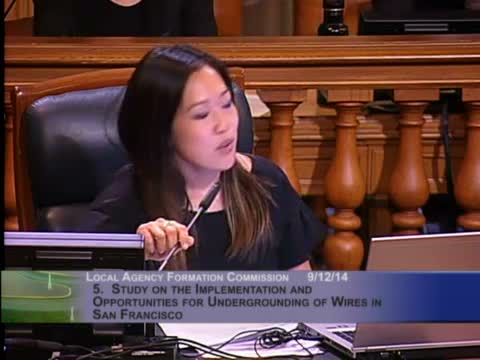
Supervisor Tang asked the San Francisco Local Agency Formation Commission on the record to study how the city can complete undergrounding its remaining overhead utility wires and to identify alternative funding and policy approaches that would advance the work more quickly and more equitably.
"Right now we have about 470 miles left of our city utility lines that have not been undergrounded," Supervisor Tang said, adding that "the estimated cost to underground these lines is actually about $3,600,000,000, which breaks down to about 7 and a half million dollars per mile." She told commissioners the work should not be confined to wealthier neighborhoods and should include geographic-equity criteria and consideration of no-new-overhead-poles policies.
Commissioners asked staff to clarify scope and sequencing. Commissioner Edwin Lindo urged that any undergrounding effort explicitly account for fiber and internet infrastructure so conduit installed now will support future technology. Commissioner Cynthia Cruz and staff discussed whether fiber analysis should be part of a single LAFCO study or produced as an initial report followed by a more technical follow-up; staff suggested a combined initial report with a later technical appendix could work.
Public commenters urged LAFCO to look for opportunities to place conduit during other large public works. Bruce Wolf described approaches to use sewer renovation projects to install conduit and reclaim rights-of-way, saying "we just need the pipe that's there, that's available, that's owned by the city." Advocates also pointed to municipal broadband examples (for instance Chattanooga) and to prior LAFCO fiber studies that suggested phased, lower-cost builds are feasible.
Supervisor Tang also asked the study to examine required street-lighting work that typically accompanies removing poles and placing utilities underground, noting those lighting costs can materially increase a project's price. Chair John Avalos motioned and commissioners agreed that LAFCO staff (Mr. Fried) should provide a scope of work for the study at the commission's next meeting, so the consultant work and departmental outreach can be scoped and timed alongside the commission's other priorities.
Next steps: staff will return to the commission with a proposed scope of work at the next LAFCO meeting; commissioners requested that the scope identify where existing "dark fiber" exists, where prior undergrounding projects were left unfinished, potential funding mechanisms, and whether conduit placement can accompany planned sewer or street projects.