Get Full Government Meeting Transcripts, Videos, & Alerts Forever!
Get email alerts on the Clean Power Sf topic
No spam. Unsubscribe anytime.
LAFCO urges 11.5¢ cap as SFPUC weighs Clean Power SF not-to-exceed rate amid labor concerns
Summary
At a joint LAFCO–SFPUC meeting, staff presented a revised Clean Power SF program rate ceiling (11.9¢) and modeling showing possible launch rates under 11¢; Commissioner Viator proposed lowering the cap to 11.5¢ and LAFCO adopted an advisory resolution recommending 11.5¢ while the PUC deferred a final vote to continue talks with labor.
San Francisco — At a joint meeting of the San Francisco Public Utilities Commission and the Local Agency Formation Commission on July 9, staff presented a revised not-to-exceed rate ceiling for the Clean Power SF Community Choice Aggregation program and outlined program design, funding for local build-out and outreach plans. LAFCO adopted an advisory resolution recommending a not-to-exceed rate of 11.5¢ per kilowatt-hour while the PUC delayed a final vote to continue labor discussions.
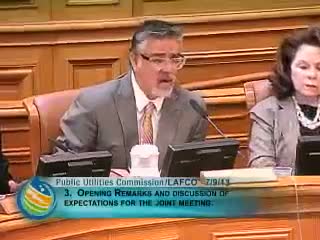
John Avalos, chair of the Local Agency Formation Commission, opened the meeting by stressing that the session would not approve a procurement contract with Shell Energy but would focus on setting a rate ceiling and next steps. "This is not the approval of a contract with Shell," he said, framing the action as setting a ceiling for possible future customer rates.
Kim Malcolm, director of Clean Power SF, walked commissioners through program history and the staff-revised numbers. She said the earlier modeled rate of 14.57¢ had been reduced through budget cuts, sourcing strategies (including REX purchases) and changes to the revenue requirement; staff proposed a not-to-exceed ceiling of 11.9¢ and said launch-day rates could be below 11¢ under current assumptions. "Today, it's 11.9¢ as we proposed it," Malcolm said, and staff also presented a plan showing an option to adopt an 11.5¢ ceiling.
Malcolm described the program's intent to deliver 100% California-certified renewable product, immediate local build-out at launch, and a customer outreach plan that includes mailers and opt-out notices in English, Chinese and Spanish. She estimated that the program's build-out margin could yield roughly $2–$4 million per year to jump-start local projects and, using a common metric of 4–6 jobs per $1 million spent, suggested the reserve-driven build-out margin could create on the order of 90 direct jobs over the initial multi-year period and many more leveraged jobs if private investment follows.
Commissioners probed differences with other CCAs: staff said Marin's lower rates reflect a different business model (no large reserve repayment, smaller staff and different product mixes) and San Francisco's policy choice of a 100% green product adds roughly 1¢ to the cost. Staff also noted that Shell had trimmed prices in negotiations and that if the program launched now, a launch rate below 11¢ was plausible under their modeling.
Labor issues were prominent in deliberations. Hunter Stern of IBEW Local 1245 criticized reliance on Renewable Energy Certificates (RECs), calling them "not real green power," and urged stronger, concrete commitments on local, union jobs and sourcing. PUC President Ed Torres said he was "not prepared to vote, for a, rate issue today," and asked staff to make a last effort to resolve substantive labor concerns before a PUC vote. Malcolm and other staff stated they intend to continue engagement with labor but also emphasized the program must function as a competitive procurement service.
Commissioner Viator moved to replace the 11.9¢ ceiling in the draft resolution with an 11.5¢ not-to-exceed rate and the chair held the motion for the public comment period. A large and mostly supportive public comment record followed: environmental groups (Sierra Club, 350.org, Local Clean Energy Alliance, San Francisco League of Conservation Voters) and numerous residents urged adoption of the lower cap to enable build-out, reduce greenhouse-gas emissions and accelerate local job creation. Other speakers representing Southeast neighborhoods and community groups asked staff to prioritize outreach and local solar/hydro opportunities, including maximizing Hetch Hetchy contributions.
After public comment, the Local Agency Formation Commission approved an advisory resolution urging the SFPUC to adopt an 11.5¢ not-to-exceed rate; the LAFCO motion was moved by Commissioner Campos and passed without objection. The PUC, which controls final rate adoption, did not take a final vote in the special morning session; the commission recessed and scheduled the not-to-exceed rate item for the regular meeting at 1:30 p.m. City Attorney staff confirmed the resolution appears on both the morning and afternoon PUC agendas.
What the action does and does not do: LAFCO's approved motion is advisory and urges the PUC to adopt the lower ceiling; no contract award or final procurement decision was made at the meeting. Commissioners and staff said additional work remains on labor outreach, build-out planning and final confirmation that conditions precedent have been met before any customer enrollments or a formal launch.
Next steps: staff said the program could take 6–8 months to launch after a final rate decision because of customer education and required regulatory steps, including finalization of procurement agreements and confirmation that the program has met conditions precedent. Malcolm and other staff said they would continue negotiations with Shell and explore bringing more procurement in-house (including potential use of Hetch Hetchy power) and would continue discussions with labor and community stakeholders.
The LAFCO advisory vote makes clear local elected and appointed officials favor the 11.5¢ ceiling as the target for competitive launch and build-out; the PUC's final afternoon vote and any subsequent contract steps will determine the program's launch timeline and precise customer rates.