Get Full Government Meeting Transcripts, Videos, & Alerts Forever!
Get email alerts on the Lafco Actions topic
No spam. Unsubscribe anytime.
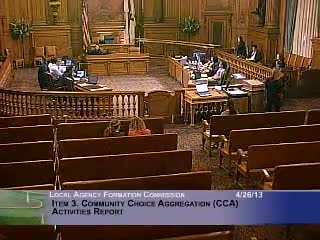
LAFCO authorizes CPUC protest letter, accepts budget approach and receives vacancy-report
Summary
The Local Agency Formation Commission authorized its chair to sign a protest letter to the California Public Utilities Commission about PG&E’s advice-letter and green-tariff filings, agreed to continue returning allocated LAFCO funds to the city, and received a report on how jurisdictions fill elected-office vacancies for possible future follow-up.
At its meeting, the Local Agency Formation Commission authorized the chair to sign a letter to the California Public Utilities Commission lodging concerns about PG&E’s advice letter and green-tariff settlement, and took several administrative actions on budget and a study of vacancy-filling procedures.
Nancy Miller, the commission’s interim executive officer, asked commissioners to authorize staff to present a protest letter to the CPUC and, if appropriate, to use stronger language than SFPUC’s filing to outline LAFCO’s concerns. The commission moved and then took the motion “without objection,” authorizing the chair to sign the letter.
The transcript records public comment from advocates urging a competitive not-to-exceed seed rate and faster program outreach; Eric Brooks (San Francisco Green Party/Our City) urged staff to set a seed rate at $0.115/kWh and include a provision allowing staff to adjust to PG&E’s rates to remain competitive.
On budget, LAFCO staff (Jason Fried) recommended following a five-year practice of returning allocated funds to the City and County of San Francisco while reserving rights for future years; commissioners moved and accepted that approach without objection.
Jason Fried also presented a study of how jurisdictions fill vacancies in elected offices. The study covered 192 offices across 31 jurisdictions and grouped approaches into (1) appointment by an individual, (2) appointment by a governing body, (3) special election, and (4) other situational approaches. Fried noted that San Francisco’s mayoral appointment practice is uncommon nationally and that any change to that approach would require a charter amendment and voter approval. The commission elected to receive and file the report for possible future consideration.
No formal roll-call votes were recorded in the transcript for the items taken "without objection," and commissioners clarified that signing a letter is typically a courtesy communication that documents discussion at the commission. Staff said SFPUC and other offices had already received some distribution packages for fact sheets and that distribution gaps would be addressed.