Get Full Government Meeting Transcripts, Videos, & Alerts Forever!
Get email alerts on the Clean Power Sf topic
No spam. Unsubscribe anytime.
New Clean Power SF director outlines build-out plan, presents rate scenarios
Summary
Kim Malcolm, newly appointed director of Clean Power SF, presented a two-part plan for local build-out and rate-making, showing not-to-exceed rate scenarios between $0.114 and $0.1457 per kilowatt-hour and options that would generate from about $0 to $36 million over 4.5 years for local projects.
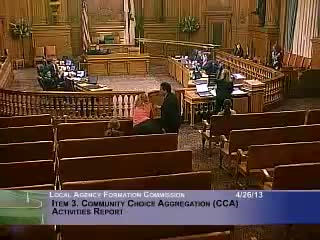
Kim Malcolm, director of the Clean Power SF Community Choice Aggregation program, told LAFCO commissioners she is optimistic the program can launch and expand but that its timing and scope depend on regulatory decisions and financing.
Malcolm, who joined the San Francisco Public Utilities Commission staff three weeks ago, said the program will combine energy-efficiency initiatives and renewable-generation procurement. She described the Shell contract as a transitional procurement and said staff plan to leverage existing local programs and target behind-the-meter investments to mitigate bill impacts.
“We plan to leverage existing programs, especially in the early years, as we try and create new ones,” Malcolm said, adding the program is committed to being “self sustaining and [not] impose unnecessary risks on the city.”
On rate-making, Malcolm gave an estimated not-to-exceed rate range of $0.114 to $0.1457 per kilowatt-hour. She compared that to a basic PG&E rate of about $0.08 per kilowatt-hour and said press reports have placed a competing green-tariff at roughly $0.115/kWh.
Malcolm walked commissioners through four scenarios that trade lower customer rates for fewer build-out reserves or higher rates to seed local projects. A REC-heavy high-rate scenario would generate about $36,000,000 over 4.5 years for build-out; an intermediate scenario would split savings and produce about $18,000,000 while lowering rates; the base case retains a higher rate but produces little or no funds for local projects.
“We might be able to squeeze the rate down a little bit more with some cost saving measures,” Malcolm said, and noted that small-scale projects and purchases via net-metering tariffs could begin quickly while larger projects likely require bonding and multi-year revenue streams.
Malcolm and staff flagged several operational constraints: interconnection delays for small projects, California Environmental Quality Act (CEQA) review for major projects, and the need for reliable revenue to support bond financing. She said the city has $2,000,000 allocated for energy-efficiency work in low-income households.
Barbara Hale, assistant general manager for power, clarified that combined heat-and-power facilities fueled by natural gas are not considered renewable, although biomethane-fueled facilities could qualify; she also said behind-the-meter combined heat-and-power does not count under California’s RPS rules toward the city’s renewable requirements.
Commissioners urged faster public outreach and distribution of fact sheets and frequently asked questions about the program, and staff agreed to post materials and coordinate communications once rate and resource decisions are firmer. Malcolm said the SFPUC’s not-to-exceed rate decision timeline depends on CPUC processes and could take months.
The presentation concluded with discussion of procurement options, potential RFP timing, and a CFO-led briefing on the city’s bonding capacity scheduled for a May meeting. The SFPUC staff indicated they will provide additional local-build details to the commission at an upcoming meeting.