Get Full Government Meeting Transcripts, Videos, & Alerts Forever!
Get email alerts on the Clean Power Sf Outreach topic
No spam. Unsubscribe anytime.
PUC endorses Clean Power SF outreach framework amid debates over pricing, equity and Shell contract
Summary
The Public Utilities Commission endorsed staff’s Clean Power SF customer-notification and education framework and a timeline tied to a Shell master agreement, while residents and advocates urged deeper outreach, pricing analysis, and protections against misleading opposition campaigns.
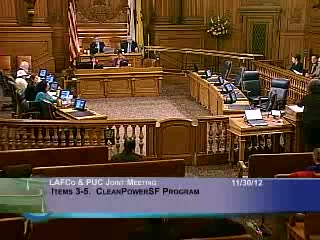
The San Francisco Public Utilities Commission on a joint LAFCO/PUC agenda endorsed a staff framework for the Clean Power SF customer notification and education program and set a timetable tied to an agreement with Shell Energy North America.
The endorsement followed a staff presentation from Barbara Hale, Assistant General Manager for Power at SFPUC, who laid out a multilingual outreach plan with door-to-door, phone-banking and multimedia elements targeted first at “deep green” neighborhoods where staff project the highest customer retention. Hale said staff expect a first-phase program sized at about 20 to 30 megawatts of local load and estimated the outreach and polling budget at roughly $1,400,000 for the coming year.
Why it matters: The endorsement commits the commission to an outreach program that precedes statutory opt-out notices and links the schedule to a final Shell contract that staff say will lock in wholesale prices. Hale told the commission the anticipated schedule calls for a signed Shell master agreement by July, a PUC confirmation in August when the commission would become financially obligated (staff estimated about $38,000,000 per year during the 4.5‑year sales period), and a program launch in October followed by the statutory opt‑out mailers.
Details and dispute: Staff presented projected bill impacts they will share with customers. For a typical Tier 1 household, SFPUC’s model showed PG&E’s electric portion at about $21.97 in 2013 and a Clean Power SF premium of about $11.54, raising the electric portion to roughly $33.50 — a 52.5% increase on the electric portion and about a 29% premium on the total PG&E bill. Hale said those premium figures include the state-mandated cost responsibility surcharge that PG&E can bill when a customer leaves bundled service; the surcharge is set by the California Public Utilities Commission (CPUC), not by SFPUC.
Commissioners pressed staff on outreach equity and on how the program will be explained to residents. Commissioner Pimentel asked how focus‑group participants will be chosen; Hale said the commission’s contractor will identify a diverse, representative group and that outreach will be regionalized by the heat‑map districts and by language. Commissioners and public commenters repeatedly urged stronger, plain‑language outreach to communities of color, seniors and limited‑English speakers and cautioned against overreliance on outside consultants.
Public comment flagged political and pricing risks. Eric Brooks of the San Francisco Green Party warned that investor‑owned utilities and related organizations would mount large campaigns against the program and urged staff to analyze pricing scenarios from Local Power that advocates say could yield more competitive rates. Francisco de Costa of Environmental Justice Advocacy said outreach must reach Districts 10 and 11 and pressed for San Franciscans to do the frontline outreach. Representatives of the Sierra Club expressed conditional support but asked staff to integrate local build‑out, jobs and financial modeling into rate scenarios.
Regulatory constraints and oversight: Hale said SFPUC has filed a revised implementation plan with the CPUC and is awaiting certification; she noted a proposed CPUC decision on a community choice aggregation (CCA) code of conduct is expected to become final within weeks, which would clarify marketing and information rules. The City Attorney’s Office (speaker on the record during the meeting) noted the proposed decision includes audits every two years to review code‑of‑conduct compliance.
Survey and timing: Staff plan a citywide customer survey in January to test the premium and refine the rollout; staff said they expect to target about 20,000 households for outreach and to hold direct conversations with approximately 5,400 households, with a stated survey confidence goal of roughly 99% and a margin of error around 2% for the targeted sample. Hale said SFPUC will present a “not to exceed” rate to the PUC in about February and the actual firm rate will be set after staff sign the confirmation with the Shell contractor; only after customers are told the actual rate will the opt‑out enrollment proceed.
Vote and next steps: Commissioner Moran moved the resolution before the PUC; it was seconded and carried on a roll call (President Art Torres — Aye; Commissioner Viator — Aye; Commissioner Moran — Aye). The PUC record shows the motion passed and staff will return with additional materials and, separately, the PUC will consider lifting a funding cap on the communications contract at a later meeting.
What remains unresolved: Advocates asked staff to delay broad outreach until Local Power proposals and updated financial modeling are fully analyzed; others worried the outreach framing could inadvertently make the program resemble an opt‑in model if not worded carefully. Staff said they will continue to coordinate with the City Attorney and the CPUC to remain within statutory requirements and to refine outreach materials and languages.
The PUC’s formal adoption at its next meeting will include a vote on releasing additional funds for the communications contractor (Davis and Associates) and any updated outreach scope; staff said they are not asking for funding release at this joint meeting. The commission also discussed but did not adopt specific door‑to‑door scripts, saying that level of detail will be developed by staff and contractors before the survey and early notification phases begin.