Get Full Government Meeting Transcripts, Videos, & Alerts Forever!
Get email alerts on the Renewable Energy Task Force topic
No spam. Unsubscribe anytime.
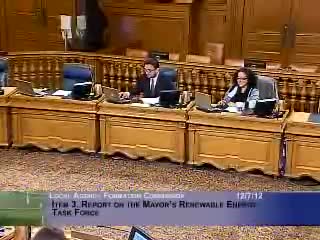
LAFCO hears Mayor—s Renewable Energy Task Force report; commissioners push to foreground Clean Power SF
Summary
At its December meeting LAFCO heard a Department of the Environment presentation summarizing a Mayor—s Renewable Energy Task Force report that recommends demand reduction, local generation, and procurement tools (including CCA). Commissioners and public speakers urged an updated addendum and stronger linkage to Clean Power SF implementation.
Danielle of the San Francisco Department of the Environment presented the Mayor—s Renewable Energy Task Force report to the Local Agency Formation Commission on the Commission—s December agenda, framing the document as a multi-pronged plan to help the city reach deep greenhouse-gas reductions in the electricity sector.
"San Francisco has a long history of climate action," Danielle said in her overview, and noted the report ties into the city—s Climate Action Plan and the SFPUC—s Electricity Resource Plan. The presentation put electricity at roughly 25 percent of the city—s emissions and cited the plan—s long-term reduction target of 80 percent by 2050. The task force, convened in early 2011 and made up of local clean-energy leaders, utilities (PG&E and SFPUC), labor and community stakeholders, met for roughly 18 months to develop recommendations.
The report groups recommendations under three broad areas: energy efficiency ("shrink the pie"), distributed or local generation, and utility-scale procurement. On efficiency, the report suggests strengthening retrofit-on-resale rules, expanding energy audits and integrating energy labeling into assessor and real-estate records so policymakers and property owners can benchmark energy use. On local generation, presenters urged streamlining permitting across the Bay Area, enabling virtual net metering for multi‑tenant buildings, and exploring feed‑in tariffs as a tool to assure developers of long-term offtake. Danielle described a feed‑in tariff as "a tool—normally 10 or 20 years—that provides an assured buyer and price so developers can obtain financing."
The task force also recommended pursuing community renewable ownership models and robust purchasing options. Danielle said Community Choice Aggregation, as planned by the SFPUC, "could play a very significant role" because a 100 percent‑renewable CCA option would directly increase city demand for renewable power and could leverage private investment.
Commissioners sought clarity on how strongly the report tied its recommendations to CCA and Clean Power SF. Commissioner Olague and Chair David Campos asked whether the Mayor—s office or task‑force deliberations led to deemphasizing CCA in the final text. Danielle replied that the report text was finalized in September and that the Mayor—s office had asked for wording that presented CCA as a possibility rather than a settled outcome; the speakers noted that Board of Supervisors approval of CCA occurred after the report text was finalized.
Public commenters who addressed the item urged further analysis and faster follow-up. Eric Brooks of the San Francisco Green Party and Our City recommended an addendum updating progress since the report—s September finalization and asked staff to "dig deep" into Local Power—s build‑out work, including use of excess Hetch Hetchy power and virtual net metering. Paul Kangas (100 Percent Solar) urged consideration of a German‑style feed‑in tariff and described a solar‑payment policy that would pay homeowners for exported generation (he cited a figure of "54¢ a kilowatt hour" as an example used in his remarks).
Danielle and LAFCO staff said some implementation work is already underway (including SunShot grant activity around permitting and financing and a separate grant from a private foundation to support planning and implementation). Commissioners asked staff to return with an updated implementation plan and suggested adopting a resolution to prioritize near‑term, mid‑term and long‑term measures.
The commission did not adopt the task‑force report as a binding policy at the meeting; it instead directed staff to pursue follow‑up work and to present prioritized, implementable steps at a future meeting.