Get Full Government Meeting Transcripts, Videos, & Alerts Forever!
Get email alerts on the Community Choice Aggregation topic
No spam. Unsubscribe anytime.
San Francisco LAFCO, SFPUC outline implementation steps after Clean Power SF approval
Summary
Following an 8-3 Board of Supervisors vote, LAFCO and SFPUC staff described next steps for Clean Power SF: prioritizing low‑income incentives, finalizing supplier and back‑office contracts, conducting targeted outreach (Rate Fairness Board review Oct. 12) and aiming to serve customers by July 2013.
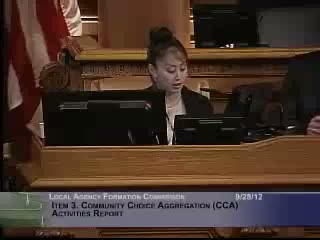
The Local Agency Formation Commission for the City and County of San Francisco on Tuesday marked the Board of Supervisors' 8–3 vote that clears the way for the city's Clean Power SF community choice aggregation program and outlined near‑term implementation steps.
Assistant General Manager Barbara Hale of the San Francisco Public Utilities Commission said the program will prioritize low‑income customers for energy‑efficiency and GoSolar SF incentives and that the board ordinance appropriated an additional $2,000,000 "for GoSolar SF for CCA customers" and for energy‑efficiency programs. "We are to provide appropriate low income discounts and incorporate a hardship fund in the rates components that we have adopted through this program," Hale said during the LAFCO meeting.
Hale described several concrete implementation tasks: finalizing the shell contract authorized for signature, completing a contract with Noble Americas for back‑office support, selecting a marketing and outreach consultant (the commission expects to consider awarding that contract at its Oct. 9 meeting), and launching a customer education and notification campaign emphasizing outreach to non‑English‑speaking communities. She said the Rate Fairness Board will meet Oct. 12 to review the staff proposal for the maximum amount each tier and type of customer could be charged for the generation portion of rates.
On schedule and process, Hale said the SFPUC is targeting a not‑to‑exceed rate adoption in the mid‑November to mid‑December window and intends to move publicity and enrollment work forward so the program can begin serving customers by July 2013. The commission also agreed to pursue a joint meeting with SFPUC staff to discuss detailed outreach and enrollment plans and to coordinate rate‑making steps.
Vice Chair John Avalos and other commissioners pressed staff on opt‑in versus opt‑out enrollment strategies and on timing for producing demonstrable outreach plans. Hale and LAFCO staff said opt‑in/opt‑out design and door‑to‑door outreach components are part of the consultant scope and that additional details will be available at a joint LAFCO–SFPUC meeting planned for late October.
Advocates who helped campaign for the program urged careful outreach and initial pricing that would limit opt‑outs. Eric Brooks of the San Francisco Green Party said advocates "strongly believe that the opt out can be brought much lower than 50% by using the proper marketing mechanisms." He added that advocates plan to work with SFPUC and LAFCO staff on outreach and said controlling the initial rate and opt‑out strategy will be critical to public acceptance.
Next steps: SFPUC staff will return with the marketing and outreach consultant proposal (commission consideration expected Oct. 9), a Rate Fairness Board hearing is scheduled for Oct. 12 to discuss not‑to‑exceed generation rates, and staff aims to finalize contracts and customer‑notification plans prior to enrollment activity.
The meeting contained no formal rate actions; those will proceed through the rate‑making and review steps described by staff.