Get Full Government Meeting Transcripts, Videos, & Alerts Forever!
Get email alerts on the Treasury Investments topic
No spam. Unsubscribe anytime.
Treasurer's office explains investment policy: fixed-income focus, six-month liquidity and $6.6–7B pool
Summary
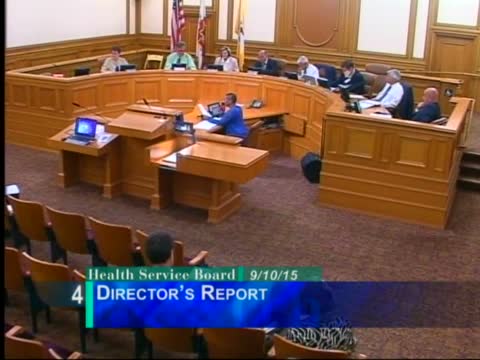
Treasury officials briefed the Health Service Board on the city pooled-investment program, saying the treasury invests in AA-or-better fixed-income securities with a five-year maximum maturity, maintains liquidity to cover six months of expenditures and manages a pool of about $6.6'$7.0 billion.
Pamela Levin and Pauline Marks of the Treasurer and Tax Collector's office told the Health Service Board the treasurer's investment program prioritizes safety and liquidity before yield and operates under a detailed investment policy constrained by state code.
Pauline Marks described the permitted investments and operational safeguards: "We invest in highly rated securities, double A or better," and "We only invest in fixed income securities with a maximum maturity of 5 years." She explained the pool invests in treasuries, federal agencies, state and local obligations, certificates of deposit, commercial paper and medium-term corporate notes, and that some money is held in money-market funds.
Marks said the treasurer uses an external custodian and delivery-versus-payment settlement to ensure securities and funds exchange correctly. She described the pool's dollar-in/dollar-out liquidity structure, meaning a depositor's dollar remains available for withdrawal, and said the treasurer certifies sufficient liquidity to meet anticipated expenditures for the next six months.
Pamela Levin discussed how investment earnings appear on HSS financial statements, noting the financial statement line that combines interest income with a net increase/decrease in fair value is a mark-to-market snapshot. As Marks put it, the net-change figure "takes into account whatever the market value was" on a single day and is intended as a risk indicator rather than a realized loss.
Board members pressed for clarity about which HSS balances appear in the treasurer's pool; staff said HSS operating balances are reported in the pool and HSS-specific balances can be viewed in the city's general ledger (FAMIS). Marks said the pool's balance ranged between about $6 billion and $8 billion and was $6.6 billion as of July 31, and that the pool's asset-allocation mix had shifted toward more corporate notes and floating-rate securities this year to mitigate rising-rate risk.
The board thanked the treasurer's staff and asked for continuing communications and periodic returns to brief the board on investment strategy, reporting and any material changes.