Get Full Government Meeting Transcripts, Videos, & Alerts Forever!
Get email alerts on the Community Choice Aggregation topic
No spam. Unsubscribe anytime.
San Francisco commissions forward CCA term sheet, approve 20–30 MW bracket and $19.5M collateral plan
Summary
The San Francisco LAFCO and Public Utilities Commission voted on Oct. 11 to forward an updated Community Choice Aggregation (CCA) term sheet to the mayor and Board of Supervisors, endorsing a 20–30 megawatt initial bracket, a $19.5 million collateral package and continued work on local build‑out and financing options.
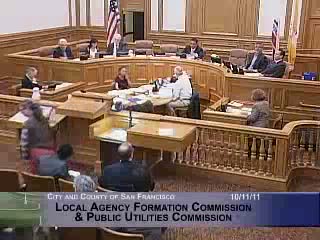
The San Francisco Local Agency Formation Commission and the San Francisco Public Utilities Commission voted on Tuesday to forward an updated Community Choice Aggregation (CCA) term sheet to the mayor and Board of Supervisors, endorsing a 20–30 megawatt initial enrollment bracket and a $19.5 million collateral package that staff said is required before contract finalization.
Commission leaders said the action does not finalize a contract but sends a recommended term sheet and proposed financing parameters to the Board of Supervisors for policy decisions. "We are sending forward a recommendation, for a proposed term sheet with the understanding that any action that's taken today is not a final action," Chair David Campos said, describing the vote as the next step in a multi‑stage approval process.
Why it matters: The term sheet sets key commercial and financial guardrails for San Francisco's Clean Power SF CCA program — including supplier contracting, customer enrollment strategy and protections the city will use to limit exposure to market risk. The package aims to let the city start with a measured enrollment while staff continues work on a local build‑out of renewable generation and on final contracting details.
What the commissions approved: Staff described the recommended commercial terms and financial safeguards during a joint meeting. Key elements include: a proposed initial contract with Shell that staff said would have a 4.5‑year initial term; a $19.5 million collateral and reserve package (staff framed this as $15 million escrow to secure the counterparty, about $4 million in reserves/lockbox and up to ~$500,000 for a secondary supplier arrangement); and a phased enrollment strategy modeled at 30 MW (roughly 75,000 residential accounts) with an option to start smaller. "The amount that the city is being contemplated ... is to have 19 and a half million dollars of collateral," said Mike Campbell, director of the Community Choice Aggregation program for Clean Power SF.
Risk and liability: Staff and commissioners discussed two principal liability scenarios. If the program failed to meet financial projections and terminated early, staff said liability to the counterparty would be capped at $15 million; if the city chose to stop a otherwise successful program, the termination exposure would be uncapped and damages would be calculated as the difference between the contract price and then‑current market value. Todd Reedstrom, assistant general manager and CFO, said the damages calculation would be based on market differences at time of termination.
How to pay for start‑up collateral: Commissioners were presented with four funding approaches to cover the $19.5 million: (1) reduce the renewable share (“de‑green”) to generate cash (staff said this would not generate enough alone); (2) roll the cost into CCA rates (staff estimated a generation component around 11–12.7¢/kWh that could translate into roughly $9/month for an average customer to recover the $19.5M over 4.5 years); (3) draw on Hetch Hetchy (hedge fund) balances; or (4) use general‑fund reserves. Staff emphasized tradeoffs for municipal customers and city budgets and said final appropriations would be a Board of Supervisors decision.
Program scale and governance change: Commissioner Anson Moran urged a cautious rollout, recommending the program be set as a 20–30 MW bracket rather than a single target to reduce exposure and allow a phased expansion. Moran also proposed that the PUC retain a final review step before any delegated execution of contracts; the commissions amended their resolutions to incorporate that language and then voted to send the term sheet and amended resolutions to the Board of Supervisors.
Public comment and local build‑out: Dozens of community advocates testified in favor of sending the term sheet to the board while urging parallel work on local asset build‑out, workforce commitments and prevailing‑wage requirements. Advocates said local generation and energy‑efficiency investments would strengthen program economics and create jobs; one advocate provided an estimate of roughly 1,000 direct jobs over five years under a full build‑out scenario.
Votes: The LAFCO resolution was amended (motion by Commissioner Avalos, second by Commissioner Schmeltzer) and passed in the joint meeting (recorded votes in the LAFCO roll call included Campos — aye; Avalos — aye; Smeltzer — aye). The PUC likewise amended and approved its version of the resolution; the chair announced the motion carried. Both commissions also approved a separate letter urging the governor and the California Public Utilities Commission to adopt a consistent bond calculation methodology for CCAs.
Next steps: Chair Campos said he will introduce the matter to the Board of Supervisors the following week; the ordinance/term‑sheet package must legally sit for approximately 30 days before a Board hearing. Staff told commissioners they aim to finalize supplier negotiations in the coming months, with enrollment activity targeted for mid‑2012 and contract execution timing dependent on the remaining regulatory and Board approvals.
What remains unresolved: The commissions left open which funding mix the Board will choose to appropriate (rates, hedge fund balances or general‑fund reserves), the final contract sizing between 20 and 30 MW, and the CPUC bond methodology that will determine bond amounts required of CCAs.
The commissions adjourned after scheduling a tentative joint meeting in December if further action is needed.