Get Full Government Meeting Transcripts, Videos, & Alerts Forever!
Get email alerts on the Community Choice Aggregation topic
No spam. Unsubscribe anytime.
SFPUC describes $19 million launch plan and liability trade-offs for Clean Power SF CCA
Summary
SFPUC staff told the San Francisco LAFCO that launching Clean Power SF would require roughly $19 million in reserves and termination-security funds, including a $15 million make-whole escrow for a Shell Energy contract; staff warned the city's liability could be uncapped if it chose to terminate a healthy program.
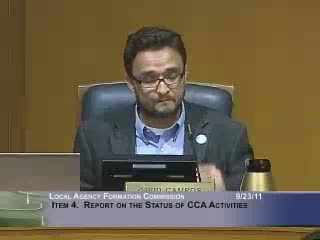
San Francisco Local Agency Formation Commission Chair David Campos on Sept. 23 heard an SFPUC presentation laying out financial terms and risks tied to launching Clean Power SF, the city's planned Community Choice Aggregation program.
Barbara Hale, assistant general manager for power at the San Francisco Public Utilities Commission, said SFPUC negotiators have reached agreement in principle with Shell Energy North America on a termination-payment concept and estimated an initial appropriation of about $19,000,000 to launch the program. That total includes a proposed $15,000,000 escrow intended as a make-whole security to cover Shell's unrecoverable losses if the city defaulted and the contract were terminated within the early years of the deal, plus roughly $4,000,000 of additional reserves to mitigate program risk.
Hale emphasized how the financial exposure depends on circumstances: if the program's business model fails and Shell cannot resell obligated power, the escrow would cap city liability at about $15,000,000; but if the program is successful and the city later decides to stop doing business with Shell, the term sheet as described would leave the city potentially exposed to uncapped liability equal to the contract value. "Our liability in the event the program does not succeed'and we're in that capped liability mode'our actual liability would be something less than $15,000,000 and it could be as low as 0," Hale said. She added that if a successful program were terminated by the city for other reasons, the liability would not be capped under the term sheet.
SFPUC staff also reported a recent Shell price refresh that reduced the estimated contract price; staff said current market conditions could support a contract price near $0.11 per kilowatt-hour. The proposed program design envisions a 30-megawatt initial CCA serving an estimated 75,000 residential accounts; a smaller 20-megawatt alternative would serve roughly 50,000 accounts, reduce the appropriation by about $1,000,000 and, staff estimated, raise customer premiums slightly.
Todd Reedstrom, SFPUC assistant general manager and CFO, walked commissioners through Hetch Hetchy's broader capital and cash-flow picture. He said the Hetch Hetchy fund balances are projected to be spent down and that, under current projections, balances could be exhausted around June 2014. Adding a $19.5 million CCA launch appropriation would further compress reserves. Reedstrom outlined options the SFPUC is considering to address the shortfall, including rate increases, cuts to programs such as GoSolarSF and energy-efficiency spending, a possible General Fund contribution, and the prospect of issuing debt if fiscal metrics can be improved and lenders are satisfied.
Commissioners and members of the public pressed for alternatives that would lower risk. Several speakers representing local clean-energy advocates urged a coordinated local "build-out" of renewable assets and energy efficiency to create revenues, reduce long-term costs and improve bonding capacity. Al Weinreb of the Local Clean Energy Alliance circulated a jobs estimate tied to a local build-out and argued that building in-city renewable resources would make a CCA more viable; Eric Brooks of the San Francisco Green Party and Joshua Arcey of Bright Line made similar points.
SFPUC staff noted regulatory questions remain: the California Public Utilities Commission has an open proceeding to reset performance-bond methodologies and SFPUC-supported legislation (SB790) was pending with the Governor. Staff recommended continued negotiation of the term sheet, further refinement of funding sources and a joint LAFCO-PUC meeting scheduled for Oct. 11 to align on outstanding items before any Board of Supervisors action.
Votes at a glance: Commissioners approved the meeting minutes (Item 2) on a motion by Commissioner John Avalos, seconded by Commissioner Hope Schmelzer, taken without objection. No formal votes were taken on the CCA term sheet or launch funds during this session.
Next steps: SFPUC and LAFCO plan a joint meeting on Oct. 11 to discuss the term sheet and funding options; SFPUC staff will continue negotiations with Shell and monitor CPUC and legislative developments.