Get Full Government Meeting Transcripts, Videos, & Alerts Forever!
Get email alerts on the Ranked Choice Voting topic
No spam. Unsubscribe anytime.
Study: small overall RCV error rate but concentrated in certain precincts and demographics
Summary
A LAFCO-briefed study of San Francisco—s 2011 ranked-choice ballots found an overall error rate of about 1.3% with some precincts approaching ~10%; higher error or bullet-voting rates were concentrated in precincts with larger Asian/Pacific Islander, Latino, older and progressive populations, and researchers recommended further targeted research.
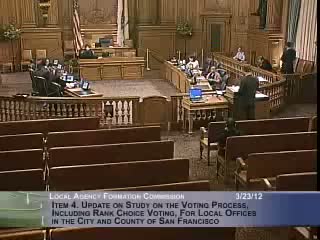
Corey Cook, a University of San Francisco professor, briefed the commission on research replicating earlier analyses of ranked-choice ballots and said the 2011 mayoral election produced a modest but concentrated set of ballot errors.
"Overall, I think 1.3% of people in San Francisco made an error that could invalidate their ballot using ranked choice voting," Cook said, and he added that in some precincts the figure was "almost 10." Cook told commissioners precincts with higher proportions of Asian and Pacific Islander residents, Latino residents, older voters and some progressive neighborhoods showed higher rates of errors or ballot behaviors (including bullet voting) that merit further study.
LAFCO staff Jason Fried said the commission has compiled most of the available Department of Elections data and is doing additional data crunching; he said staff plan to present basic numbers and a more formal presentation at the next LAFCO meeting. Cook recommended further research steps including an RFP-funded study, survey research and focus groups targeted at monolingual populations, and experimental ballot-design work to test whether layout changes reduce the observed disparities.
Commissioners asked about definitions used in the study. Cook explained the difference between ballots with errors (for example, overvotes) and ballots actually invalidated in the count; he said the study distinguishes between overvotes that did not invalidate a ballot and those that did, and that the Department of Elections— categorization influenced how bullet voting and other behaviors were treated in the analysis.
Next steps: LAFCO staff expect to return with a more detailed presentation of data and analysis at the commission—s next meeting; Cook said his team planned to post the 2011 report to the public and encouraged the commission to consider commissioning additional research.