Get Full Government Meeting Transcripts, Videos, & Alerts Forever!
Get email alerts on the Refuse Collection Study topic
No spam. Unsubscribe anytime.
R3 Phase 2 finds no clear link between hauler fees and diversion; recommends further analysis of barging and asset values
Summary
R3's Phase 2 report to LAFCO found no direct correlation between jurisdiction fees/free services and diversion or customer rates, cataloged Recology's San Francisco assets (two owned sites and three leased) and outlined barging trade-offs; commissioners accepted the report and forwarded it to the Board of Supervisors.
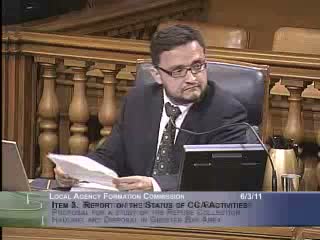
LAFCO reviewed Phase 2 of R3's refuse collection, hauling and disposal study on June 3, 2011. R3 summarized data from 13 jurisdictions and examined fees and services, the relationship between fees and diversion rates, fixed assets held by Recology in San Francisco, and the potential consequences and benefits of barging.
Rick Hutchinson of R3 said the analysis did not find a direct correlation between a jurisdiction's fees or free/discounted services and customer rates or diversion rates. "What we saw was that there was not a direct correlation between those numbers," Hutchinson said. He said the study compiled gross revenues, franchise and other fees, and calculated a fee-and-service percentage for each jurisdiction.
The report identified five Recology sites in San Francisco (three leased and two owned). Hutchinson noted the two owned properties as the Tunnel and Beatty complex and the site at 900 and Seventh Street and said the report lists appraised, cost and book values for owned properties where available.
On barging, R3 said potential benefits include removing truck traffic and lowering greenhouse gas emissions, but there are potential environmental and cost trade-offs: waterway impacts and transfer-time and distance can make barging more expensive. Hutchinson cautioned that barging's competitiveness depends on the transfer logistics and the final landfill location.
Public commenter Tony Kelly (Potrero Hill) voiced several methodological concerns: he questioned R3's assumption that average commercial rates in San Francisco are 50% of published commercial rates, disputed the report's presentation of $18,000,000 in free services credited to Recology without detailed breakdowns, and said the barging analysis ignored other landfills that could have made barging appear more competitive.
Commissioner Avalos asked R3 to clarify how the 50% commercial-rate assumption was derived; R3 said the figure came from the city's Department of the Environment rate calculator and conversations with Recology and staff. "We were informed that the average commercial business in San Francisco has approximately 50% capacity," Hutchinson said.
Commissioner Mercurini praised the new detail the report provides about the city's relationship with Recology and urged continued development of port and barging options while acknowledging potential capital costs. Staff noted a resolution in the packet to accept Phase 2 and forward it to the Board of Supervisors. Commissioner Mercurini moved to accept and forward the report; the motion was seconded and adopted without objection.
What happens next: LAFCO accepted Phase 2 and will forward the report and staff resolution to the Board of Supervisors; commissioners and staff flagged remaining methodological questions (commercial-rate assumptions, free-services accounting and expanded barging scenarios) for further review.