Get Full Government Meeting Transcripts, Videos, & Alerts Forever!
Get email alerts on the Community Choice Aggregation topic
No spam. Unsubscribe anytime.
LAFCO hears Clean Power SF update; SFPUC projects 'high 40%' opt-out rate
Summary
SFPUC staff told the Local Agency Formation Commission that a preliminary citywide opt-out estimate for the Clean Power SF community choice aggregation program is in the 'high 40%' range, and said targeted outreach and program design could lower that figure; CPUC proceedings and Board of Supervisors hearings were also disclosed.
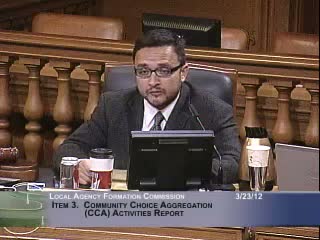
Mike Campbell, the SFPUC director for the city—s Community Choice Aggregation program known as Clean Power SF, told the San Francisco Local Agency Formation Commission on March 23 that staff currently estimate a citywide opt-out rate in the "high 40%" range for default enrollment into the program.
Campbell said SFPUC staff are finalizing required back-office services (customer call center, customer tracking and billing) with Noble Americas and are coordinating with the Board of Supervisors on an appropriation for collateral and a shell energy-supply contract; he said the GAO subcommittee will hold an initial hearing on April 12 with subsequent Board hearings to follow.
The SFPUC intends to refine its opt-out estimate through more granular market research and statistical modeling that overlays attitudinal survey data with demographic and precinct-level voting patterns. "We think that really, you know, a reasonable estimate of the opt out rate just on the citywide as a whole would be in the high 40%," Campbell said. He added that targeted outreach and choosing initial launch areas carefully could drive the opt-out rate lower.
Campbell also described related regulatory and rulemaking activity at the California Public Utilities Commission. He said the CPUC is taking up issues including guidance on any required performance bond for CCAs and an enhanced code of conduct limiting how investor-owned utilities may use marketing and utility resources with respect to CCAs; SFPUC and other CCA advocates will file an initial set of comments on the code of conduct (first comments due the Monday following the meeting) and reply comments due April 16. Campbell estimated CPUC action on bond-related items "at the earliest" by August.
During public comment, Eric Brooks of the San Francisco Green Party and Our City told commissioners advocates want to ensure the program results in "hundreds of megawatts of local renewables and efficiency" and described a Local Power proposal to offer share-based ownership that could help reach price parity with PG&E. "They think they can use this method... and that would drastically reduce the opt out problem," Brooks said.
LAFCO staff and SFPUC staff said they have been meeting with advocates and that no formal action by LAFCO was required on the informational presentation at this meeting. The commission did not vote on any Clean Power SF policy at this session.
Next steps: SFPUC and LAFCO staff will continue market research and targeted outreach planning; SFPUC and partner parties will file comments with the CPUC as noted and the Board of Supervisors will hold hearings beginning with the GAO subcommittee on April 12.