Get Full Government Meeting Transcripts, Videos, & Alerts Forever!
Get email alerts on the Clean Power Sf topic
No spam. Unsubscribe anytime.
SFPUC presents survey findings and recommends 100% renewable Clean Power SF with phased rollout
Summary
PUC staff recommended launching Clean Power SF as a 100% renewable, greenhouse-gas-free Community Choice Aggregation product after a customer survey of 823 households showed a core base of support and a large persuadable group; commissioners pressed staff on rates, equity and timing for a phased launch targeting 75,000 accounts.
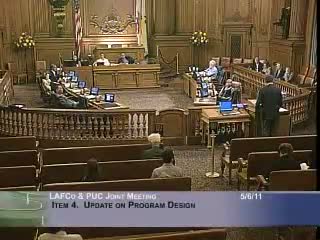
San Francisco — San Francisco Public Utilities Commission staff told a joint meeting with the city’s Local Agency Formation Commission on May 6 that they recommend launching Clean Power SF as a 100% renewable, 100% greenhouse-gas-free Community Choice Aggregation product and phasing enrollment geographically to build operational experience.
Barbara Hale, assistant general manager for power at the SFPUC, said the recommended product would rely on California-compliant renewable portfolio resources and run in parallel with local efforts to develop city-owned renewables and energy-efficiency programs. "We recommend a 100% renewable product ... a 100% greenhouse gas free product," Hale said during the presentation.
The recommendation followed findings from a customer attitudes survey conducted by Fairbank, Maslin, Metz & Associates (FM3). David Metz, the pollster, said FM3 completed 823 interviews with residential electricity customers across the city, stratified by rate tier to oversample high-usage customers. The overall margin of error for the completed survey was about ±5.7%. Metz summarized that 37% of respondents said they would stay with Clean Power SF based on a conceptual description of the program, 31% said they would opt out, and 32% were undecided until they heard specific rate impacts.
Metz also reported tiered sensitivity to price: in a scenario where Clean Power SF would be 40% renewable and 100% GHG-free, Tier 1 customers indicated roughly 60% would stay even if it cost $6–$8 more per month, while higher tiers showed larger opt-out rates. Testing a 100% renewable, 100% GHG-free scenario produced only modest additional drop-off in most tiers. "Even for tier 5 customers," Metz said, "we still have 17% that say they would stay with Clean Power SF." The pollster noted geographic differences too, with the highest interest in the Northeast quadrant of the city and the lowest in the Southwest.
Commissioners pressed staff on program details, including how frequently customers move between PG&E usage tiers and whether customers receive advance notice of tier changes. Hale explained tier placement is determined month-to-month by kilowatt-hour usage and customers typically learn about a tier change after billing. Commissioners also questioned how PG&E’s pending proposal to flatten generation rates would affect the Clean Power SF premium; staff said a flat-generation decision at the California Public Utilities Commission would change the premium Clean Power SF would need to charge by tier and could increase participation among lower-tier customers.
The SFPUC and general manager said the staff proposal would phase the rollout, targeting about 75,000 accounts in phase one (roughly a 30-megawatt program) to establish operational experience and a customer base before expansion. Staff emphasized energy-efficiency and demand-response programs would be offered in parallel to help reduce total bills even if per-kilowatt-hour costs change.
Commissioners and members of the public raised equity concerns. Staff said existing low-income discount programs such as PG&E’s CARE would continue and the commission will work to ensure low-income customers are included and protected in program design. The general manager said the CARE discount currently covers a large portion of typical low-income customer bills but that staff would calculate program-specific effects.
Public commenters voiced both support and criticism. Eric Brooks, representing local grassroots groups, argued the FM3 survey was flawed because it excluded commercial customers, which account for most electricity sales in the city, and urged simultaneous local build-out to lower costs. Jeremiah Dean of the Sierra Club said the organization supported a 100% renewable, nuclear-free product.
Staff also briefed commissioners on regulatory and legislative matters tied to CCA implementation, including CPUC activity on exit fees charged to customers leaving investor-owned utilities and state legislation (SB 970) intended to clarify implementation issues in AB 117.
Next steps: staff sought guidance on the design parameters — product mix, phasing and rate strategy — and indicated a likely launch window in mid-2012 pending regulatory developments and further planning. The joint meeting continued items related to program design to the call of the chair for follow-up.
The SFPUC presentation and the FM3 survey provide the staff’s recommended baseline for Clean Power SF; commissioners asked for additional work on low-income protections, coordination of energy-efficiency funding and outreach to persuade undecided customers.