Get Full Government Meeting Transcripts, Videos, & Alerts Forever!
Get email alerts on the Clean Power Sf topic
No spam. Unsubscribe anytime.
San Francisco officials review Clean Power SF progress as negotiations with PG&E continue
Summary
San Francisco LAFCO and SFPUC held a joint session April 23 to review Clean Power SF implementation, ongoing PG&E service-agreement negotiations and a still-unfinalized energy service contract; staff warned PCIA and business terms make meeting a 51% renewable goal by 2017 difficult without tradeoffs, and public speakers urged a contract before the June ballot.
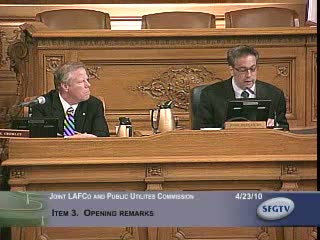
A joint meeting of the San Francisco Local Agency Formation Commission and the San Francisco Public Utilities Commission on April 23 focused on the city—s Clean Power SF community choice aggregation program and negotiations over the service agreement with Pacific Gas and Electric Company and a private energy service provider. Staff outlined remaining business terms, cost tradeoffs and the risk allocation that must be resolved before a final contract can be presented.
Staff presentations by Barbara Hale, assistant general manager for Power, and Ed Harrington, SFPUC general manager, said the implementation plan was submitted to the California Public Utilities Commission (CPUC) on March 3, that PG&E filed comments April 2 and staff replied April 9, and that CPUC certification is expected in early May (the statute allows the CPUC until June 3). Hale summarized three parallel tracks for Clean Power SF: CPUC certification of the implementation plan, negotiation of the PG&E service agreement, and finalizing the energy services contract with the selected bidder.
Hale and Harrington emphasized that costs outside pure generation—particularly the Power Charge Indifference Adjustment (PCIA)—follow customers who leave PG&E and are an important program expense. "The PCIA charges are expected to be approximately $15 a megawatt hour for our customer base," Hale said, and staff estimated that PCIA would amount to about $60,000,000 a year out of roughly $350,000,000 in program customer revenues. Harrington provided the staff—s view of the market costs: "PG&E generation rate — about $80 per megawatt hour— and the PCIA is about worth about $15 of that total," he said.
The discussion turned to renewable energy credits (RECs) after a CPUC decision allowed some unbundled RECs to count toward RPS compliance. Hale explained the distinction between bundled RECs and unbundled ("green") RECs and described the two certification paths in California: WREGIS/Regis (RPS-compliant) and Green-e (third-party verified but not state-sanctioned). "Only the Regis RECs are allowed by the California PUC to be used for compliance for the investor owned utilities like PG&E," Hale said, and the staff asked the joint bodies for guidance on whether Clean Power SF should use RECs to meet its renewable portfolio targets.
Staff said RECs can lower portfolio costs but that relying on unbundled RECs would mean the program delivers attributes rather than the physical renewable energy to customers in the near term. "If you buy wrecks, you also have to actually buy energy," Harrington said, describing the tradeoff that unbundled RECs can green a portfolio on paper while providing less delivered renewable generation.
Commissioners asked technical and policy questions about the timeline, program staffing, the degree to which the mayor's office is involved and the range of contract terms staff is considering. Nancy Miller, LAFCO executive officer, described intensive, near-daily work with the potential energy service provider and said mediation with PG&E was scheduled. "We are planning on meeting, if not every day, virtually every day with the energy service provider until we have that contract to bring back to you," Miller said.
On economic scenarios, staff reported difficult tradeoffs: in some models, reaching a 51% renewable target by 2017 without raising rates would require a heavy mix of unbundled RECs in early years and could produce portfolios that are not RPS-compliant or that do not meet expectations for delivered renewables. Harrington said he and staff have modeled scenarios with longer contract terms and with termination liabilities; "we have had discussions where the only way that we could get a 51% is if we committed to raise rates whenever and as much as we were requested to raise rates, which is a violation of the city's charter," he said. In another scenario staff said they modeled a 10-year contract with a potential early-termination fee in the order of $140,000,000.
Commission members debated tradeoffs. Commissioner Campos urged expedited attention and said he expected CCA to be the PUC's top priority ahead of the June election. Other commissioners urged fiscal caution and asked staff to return with more detailed modeling and a draft term sheet. Mike Campbell, director of the Clean Power SF community choice program, said market research indicates potential customers are more sensitive to price than to renewable percentage, and that opt-out behavior tends to respond to price changes more than to renewable mix.
Public comment strongly favored moving the contract forward. Speakers from the Sierra Club and other local environmental groups urged immediate action to secure renewable procurement and local green jobs. "It is so disappointing that we don't have a contract at this point," said John Rizzo of the Sierra Club. Other public commenters criticized past PUC priorities and urged consistency in committing the necessary resources and policy leadership.
The joint meeting took several procedural votes after discussion. Commissioner Campos moved to file the status-report item (seconded by Commissioner Avalos); the motion carried. The body then moved into closed session to confer with legal counsel and subsequently voted not to disclose closed-session deliberations. The LAFCO minutes for March 2010 were approved and the proposed fiscal-year 2010–11 LAFCO budget was continued.
Why it matters: Clean Power SF is intended to give San Francisco ratepayers a locally governed option for cleaner power, with a city goal of 51% renewables. Staff told commissioners that program economics, state-level PCIA charges and unresolved risk allocation in the energy service contract are the main impediments to presenting a final, acceptable contract this month. The commission asked staff to continue negotiations, further model alternatives (including term length, the renewable mix and implications for rate comparability to PG&E) and return with more concrete term-sheet proposals and financial scenarios.
Votes at a glance: - Motion to file status report (Item 4): moved by Commissioner Campos, seconded by Commissioner Avalos; outcome: approved. - Move into closed session on legal matters: moved and approved; subsequent motion not to disclose closed-session discussions: moved by Commissioner Campos, seconded by Commissioner Borenstein (and corresponding SFPUC motion moved by Commissioner Moran, seconded by Commissioner Ellis); outcome: approved. - Approval of March 2010 special meeting minutes: moved by Commissioner Bornstein and Commissioner Campos; outcome: approved.
What—s next: Staff said it expects CPUC action on the implementation plan in early May and will pursue mediated negotiations with PG&E and continuing term-sheet work with the energy service provider. Commissioners asked for further modeling on mixes, term lengths, termination liabilities and a clearer accounting of conservation and other program assets that could offset costs.
Quotes (representative): "The PCIA charges are expected to be approximately $15 a megawatt hour for our customer base," Barbara Hale said. "If you buy wrecks, you also have to actually buy energy," Ed Harrington said, warning that unbundled RECs do not provide physical energy to customers. "We are planning on meeting, if not every day, virtually every day with the energy service provider until we have that contract to bring back to you," Nancy Miller said.
The joint meeting closed with a vote to keep closed-session deliberations confidential and with staff directed to continue negotiations and return with updated analysis and draft business terms.